Dueling Polygraphs in Pittsburgh Beating Case

Jordan Miles
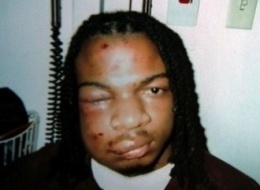
Jordan Miles after police beating

Three Pittsburgh police officers who stand accused of wantonly beating 18-year-old honor student Jordan Miles have all passed lie detector tests. But Miles also passed a lie detector test regarding the incident. So whose lie detector is lying?

Jill King Greenwood reports for the Pittsburgh Tribune-Review:

Three Pittsburgh police officers accused of beating a Homewood teenager during a January arrest near his home passed polygraph tests over the weekend, the president of the police union said.

Officers David Sisak, Richard Ewing and Michael Saldutte took the tests from a private polygraph administrator at the same time that nearly 100 other city officers marched in the St. Patrick’s Day Parade Downtown on Saturday wearing T-shirts in support of the three, who are on paid administrative leave while the city and FBI investigate the Jan. 12 incident.

Read more

NSA Leaflet: Your Polygraph Examination

Your Polygraph Examination
Detail from NSA Polygraph Leaflet

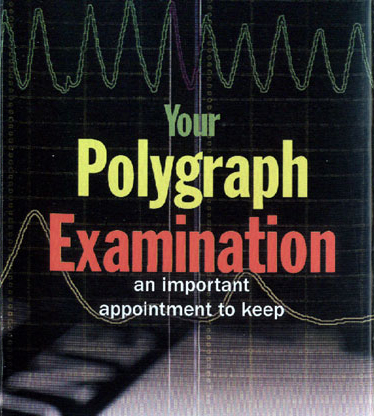
AntiPolygraph.org has obtained a copy of an NSA leaflet (1.7 mb PDF) titled, “Your Polygraph Examination: An Important Appointment to Keep.” This leaflet, which has blanks for filling in the time, date, and place of an appointment, merits some discussion.

The leaflet begins with a section on what to do before the polygraph:

Prior to Your Appointment
  • Get a good night’s sleep
  • Follow your usual routine
  • Take your regular medications
  • Don’t skip any meals
  • Come in with an open mind
  • It’s a unique experience each time
  • Allow enough time in your schedule

This much is fairly uncontroversial. But while the NSA urges keeping an “open mind” about the polygraph, we should also heed evolutionary biologist Richard Dawkins’ wise counsel: “By all means let’s be open-minded, but not so open-minded that our brains drop out.” The National Academy of Sciences in 2002 found polygraph screening to be completely invalid, concluding that “its accuracy in distinguishing actual or potential security violators from innocent test takers is insufficient to justify reliance on its use in employee security screening in federal agencies.”

Read more

An Example of How the Myth of the Lie Detector Is Perpetuated

An article published today in a small town newspaper provides a good example of the sort of shoddy reporting that perpetuates the myth of the lie detector. Lisa Rogers reports for the Gadsden, Alabama Times:

Polygraphs useful law enforcement tool
By Lisa Rogers
Times Staff Writer
Published: Saturday, March 6, 2010 at 9:37 p.m.

A suspect in a sex crime confessed after failing a lie detector test and even confessed to trying to beat the test by doing research on the Internet.

There are several Web sites that claim to have information that teaches someone how to beat a test, said Fred Lasseter, a licensed polygraph examiner and investigator with the Etowah County Sheriff’s Office.

“They tell you things to do to try to beat the system,” Lasseter said, “but beating it takes years of practice. It is very difficult to try to manipulate the system.”

Polygraph operator Fred Lasseter is lying. It doesn’t take “years of practice” to learn how to beat a lie detector test, nor is it difficult. In peer-reviewed research (cited in the bibliography of The Lie Behind the Lie Detector), about half of test subjects were able to fool the polygraph with no more than 30 minutes of training. The fact that a stupid criminal failed to pass a lie detector test and confessed should not be misconstrued as evidence that 1) the polygraph is difficult to beat or 2) that the polygraph is accurate as a lie detector. It is neither.

Read more

DOJ Rationalizes Away Polygraph’s Failure to Catch Alleged Anthrax Killer Bruce Ivins

Bruce E. Ivins
Bruce E. Ivins

On Friday, 19 February 2010, the U.S. Department of Justice announced the conclusion of its investigation into the 2001 anthrax attacks. The DOJ maintains that  Dr. Bruce Edwards Ivans, who in 2002 passed a polygraph test regarding the anthrax attacks, was the sole perpetrator.

In an investigative summary (640 kb PDF), the DOJ characterizes Ivins’ passing of the polygraph as part of an effort to “stay ahead of the investigation,” alleging (at p. 84, fn. 51) that he used countermeasures to fool the polygraph:

In some sense, Dr. Ivins’s efforts to stay ahead of the investigation began much earlier. When he took a polygraph in connection with the investigation in 2002, the examiner determined that he passed. However, as the investigation began to hone in on Dr. Ivins and investigators learned that he had been prescribed a number of psychotropic medications at the time of the 2002 polygraph, investigators resubmitted his results to examiners at FBI Headquarters and the Department of Defense Polygraph Institute for a reassessment of the results in light of that new information. Both examiners who independently reassessed the results determined that Dr. Ivins exhibited “classic” signs of the use of countermeasures to pass a polygraph. At the time the polygraph was initially examined in 2002, not all examiners were trained to spot countermeasures, making the first analysis both understandable under the circumstances, and irrelevant to the subsequent conclusion that he used countermeasures.

Although the summary doesn’t state what “classic” signs of countermeasures Ivins allegedly displayed, Michael Isikoff of Newsweek reported in 2008 that the FBI “concluded he’d used ‘countermeasures’ such as controlled breathing to fool the examiners.”

Read more

Former Aide to Colin Powell Accused of Espionage, Fired Based on Polygraph Results

A recently filed federal lawsuit documents how a veteran intelligence officer with the Defense Intelligence Agency (DIA) was accused of espionage and summarily fired after failing a series of polygraph “tests” (a procedure roundly rejected by scientists as being without scientific basis). The following is an excerpt from the statement of complaint (160 kb PDF) … Read more

CIA Polygraph Operators Need to Have Their Heads Examined

In a commentary addressing the case of retired CIA polygrapher John F. Sullivan, who is suing the CIA after failing a polygraph test for post-retirement contract employment, Congressional Quarterly National Security editor Jeff Stein, himself a veteran Army Intelligence case officer, proposes that CIA polygraphers — who “claim to be able to read the inner … Read more

How Tom Henry Beat the Polygraph

In an oral history posted on YouTube, musician Tom Henry recounts the story of how, as a young Navy seaman, he was caught with a pound of marijuana in his locker, but escaped punishment after fooling the lie detector: The technique Tom thought of for fooling the lie detector (dissociation) wasn’t very sophisticated. But it … Read more

Penn & Teller Bullshit! Lie Detector Episode

As has been discussed on the message board, Penn Jillette, the “bigger, louder half” of the magic and comedy duo Penn & Teller, has disclosed via Twitter that a forthcoming episode of the Emmy Award-winning Showtime series Penn & Teller Bullshit! will concern “the bullshit of lie detectors.” AntiPolygraph.org anticipates that this PTBS episode will … Read more

Texas Department of Public Safety Brouhaha Over Polygraph Policy

Mike Ward, staff reporter for the Austin American-Statesman reports that — much to the horror of the state’s Public Safety Commission — the Texas Department of Public Safety has hired applicants who failed lie detector tests. Unfortunately, left out of the report is any mention of the fact that polygraphy has no scientific basis. The proper question is not why are applicants who failed this bogus test being hired, but why is the state of Texas relying on this pseudoscience to screen applicants?

Ward reports:

Some Texas Department of Public Safety troopers have been hired despite failing polygraph tests on their background checks, while others have been hired after admitting to past criminal behavior, agency officials said Thursday.

With legislative pressure already on DPS officials to ensure that state troopers meet the highest standards, officials made a number of disclosures at a meeting Thursday with the Public Safety Commission, which oversees the department.

Some members of the current training academy class of more than 100 failed polygraph tests on background checks. Others who failed polygraphs have been hired in the past.

Some recruits in the past were accepted after they admitted to past criminal behavior during interviews, even if they were never arrested or charged.

“More than a handful” were rejected by other law enforcement agencies before they applied to the DPS.

Others have been promoted from the training academy and put to work despite recommendations from training supervisors that they be dismissed.

“Wow!” said Commissioner Ada Brown of Dallas, after hearing the details at the meeting.

Despite some recruits’ deception on the polygraph tests, “you give him a badge?” she asked Capt. Phillip Ayala, who was in charge of recruiting, and human resources director Paula Logan. “I have a problem with that.”

Read more
Massachusetts Police Face Polygraph Dragnet

Although pre-employment polygraph screening of law enforcement officers is prohibited by law in the state of Massachusetts, such protection against the pseudoscience of polygraphy evidently ceases upon hiring. In the town of Dracut, some 40 police officers either have been polygraphed or face polygraphic interrogation regarding the disappearance in 2003 of a quantity of marijuana … Read more