
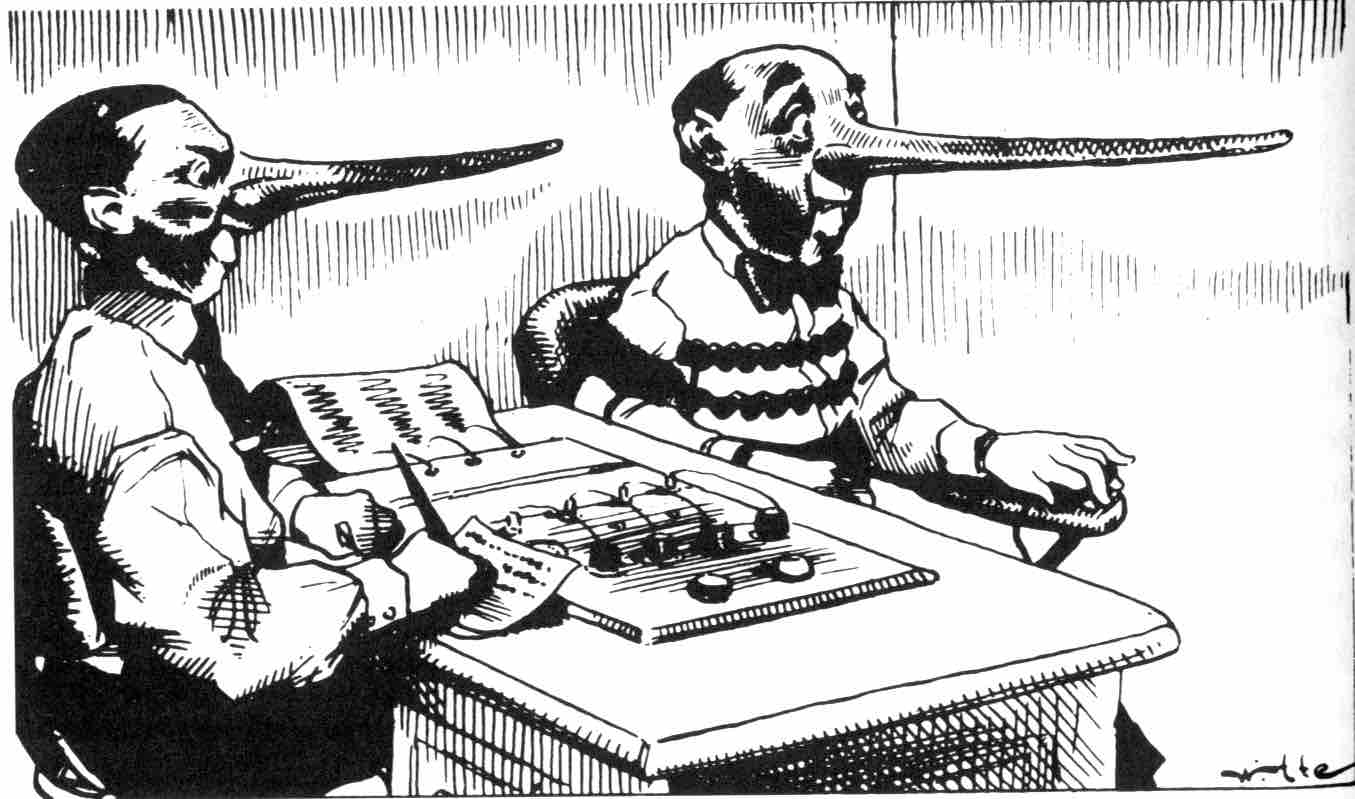
 Make-believe science yields make-believe security.
Did you know:
- The consensus view among scientists is that polygraph testing has no scientific basis?
- The FBI considered the creator of the lie detector test to be a phony and a crackpot?
- The man who started the CIA's polygraph program thought that plants can read human thoughts?
- The foremost polygraph advocate in academia was discredited by a federal judge?
- The longest polygraph school produces newly minted polygraphers in just 14 weeks -- less than half the time it takes to graduate from a typical barber college?
- The National Center for Credibility Assessment (the erstwhile DoD Polygraph Institute) suppressed a study suggesting that innocent blacks are more likely to fail the polygraph than innocent whites?
- The researcher who developed the U.S. Government's polygraph Test for Espionage and Sabotage "thought the whole security screening program should be shut down?"
- The National Academy of Sciences concluded that "[polygraph testing's] accuracy in distinguishing actual or potential security violators from innocent test takers is insufficient to justify reliance on its use in employee security screening in federal agencies?"
- Spies Ignatz Theodor Griebl, Karel Frantisek Koecher, Jiri Pasovsky, Larry Wu-tai Chin, Aldrich Hazen Ames, Nicolás Sirgado, Ana Belen Montes, and Leandro Aragoncillo all passed the polygraph?
- One of the most prolific serial killers in U.S. history passed the polygraph and killed again, while an innocent suspect failed?
- You don't have to be a psychopath, go to spy school, or somehow believe your own lies to fool the polygraph? (We'll reveal how it's done.)
The Lie Behind the Lie Detector
(also available in EPUB and MOBI/Kindle formats)
The dirty little secret behind the polygraph is that the "test" depends on trickery, not science. The person being "tested" is not supposed to know that while the polygraph operator declares that all questions must be answered truthfully, warning that the slightest hint of deception will be detected, he secretly assumes that denials in response to certain questions -- called "control" questions -- will be less than truthful. An example of a commonly used control question is, "Did you ever lie to get out of trouble?" The polygrapher steers the examinee into a denial by warning, for example, that anyone who would do so is the same kind of person who would commit the kind of behavior that is under investigation and then lie about it. But secretly, it is assumed that everyone has lied to get out of trouble.
The polygraph tracings don't do a special dance when a person lies. The polygrapher scores the test by comparing physiological responses (breathing, blood pressure, heart, and perspiration rates) to these probable-lie control questions with reactions to relevant questions such as, "Did you ever commit an act of espionage against the United States?" (commonly asked in security screening). If the former reactions are greater, the examinee passes; if the latter are greater, he fails. If responses to both "control" and relevant questions are about the same, the result is deemed inconclusive.
The test also includes irrelevant questions such as, "Are the lights on in this room?" The polygrapher falsely explains that such questions provide a "baseline for truth," because the true answer is obvious. But in reality, they are not scored at all! They merely serve as buffers between pairs of relevant and "control" questions.
The simplistic methodology used in polygraph testing has no grounding in the scientific method: it is no more scientific than astrology or tarot cards. Government agencies value it because people who don't realize it's a fraud sometimes make damaging admissions. But as a result of reliance on this voodoo science, the truthful are often falsely branded as liars while the deceptive pass through.
Perversely, the "test" is inherently biased against the truthful, because the more honestly one answers the "control" questions, and as a consequence feels less stress when answering them, the more likely one is to fail. Conversely, liars can beat the test by covertly augmenting their physiological reactions to the "control" questions. This can be done, for example, by doing mental arithmetic, thinking exciting thoughts, altering one's breathing pattern, or simply biting the side of the tongue. Truthful persons can also use these techniques to protect themselves against the risk of a false positive outcome. Although polygraph operators frequently claim they can detect such countermeasures, no polygrapher has ever demonstrated any ability to do so, and peer-reviewed research suggests that they can't.
Latest News:
Criminally Charged Polygrapher Regan Goan Fingered by Erstwhile Employee, Polygrapher Ben Sweeney
Emily Allen of the Portland Press Herald provides the most detailed reporting to date on the case against former Cumberland County, Maine Sheriff's Office deputy and polygraph operator Regan J Goan.
Update on Arrest of Maine Polygraph Operator Regan J. Goan
New details of the charges have emerged.
Jesselyn Radack on Pete Hegseth's Polygraph Theater
National security lawyer Jesselyn Radack rakes the Secretary of Defense over the coals over his efforts to suppress unfavorable media coverage.
Steve Wilkos Takes a Lie Detector "Test"
You'll never guess who "tested" him!
Pentagon Seeks Funding for New and Improved Polygraph
Now with more magical thinking!
Former Law Enforcement Polygrapher Regan J. Goan Charged with Polygraph-related Misconduct
Or, "Witch Doctor Charged with Malpractice." A former Cumberland County, Maine Sheriff's Office deputy has been charged with a series of misdemeanor charges related to his work as a polygraph operator.
DoD Conducts Abortive Polygraph Dragnet of Joint Staff and CENTCOM Personnel in Leak Investigation
In August 2026, some 50 individuals were reportedly subjected to polygraph screening about media contacts, and all reportedly passed. Don't you feel safer now?
Fraud Alleged in U.S. Secret Service Polygraph Contracting
AntiPolygraph.org has learned that a whistleblower complaint is pending with the General Services Administration Office of Inspector General alleging bid-rigging and pay-to-play activities in the awarding of polygraph contracts.
Government-controlled Reddit Community for U.S. Secret Service Applicants Bans Discussion of Polygraphs
Federal agents who run the social media subforum think you shouldn't research the polygraph.
U.S. Secret Service Polygrapher Kenneth Premo Arrested
The 50-year-old senior special agent faces misdemeanor and felony charges for driving while under the influence of alcohol, assault on a law enforcement or corrections officer, and sexual battery.
DHS Personnel Reportedly Polygraphed by U.S. Air Force Polygraphers
A report by the Guardian suggests that the Department of Homeland Security has been subjecting employees to polygraph screening by non-DHS polygraphers.
Costa Rica Sacks Police Directors After Polygraph Screening
But all members of President Laura Fernández Delgado’s cabinet passed.
Ed Gelb, RIP
Celebrity polygraph operator Edward Ira Gelb is reported to have died in 2021. There was no timely news coverage of his death.
House Intelligence Committee Democrats Seem to Believe in the Polygraph
Democratic members of the House Permanent Select Committee on Intelligence want Acting Director of National Intelligence nominee Bill Pulte to be subjected to polygraph screening.
Senator Warner on Polygraph Screening for Acting Director of National Intelligence Bill Pulte
The Vice Chairman of the Senate Select Committee on Intelligence thinks that President Trump's nominee to serve as Acting Director of National Intelligence should take a polygraph "test."
End of The Steve Wilkos Show
In some rare good news on the polygraph front, The Steve Wilkos Show, which for years promoted public belief the myth of the lie detector, has been canceled.
Costa Rican President Laura Fernández Delgado Orders Officials to Submit to Polygraph Screening
Ignoring science, the new 39-year-old president of Costa Rica is attempting to combat corruption through the magical thinking of polygraphy.
Senior CIA Officer David John Rush Evidently Beat the Polygraph
The CIA's polygraph program seems to have neither detected nor deterred him from lying about his education and military service, or from embezzling millions of dollars worth of property.
China Allegedly Conducted Operational Source Polygraph Testing of U.S. Agent
An FBI affidavit filed in a criminal case notes that Thomas Weir Pauken II, whom the U.S. government believes acted as an agent of the Chinese Ministry of State Security, was subjected to a polygraph examination and asked whether he was working for the CIA.
FBI Director Kash Patel Orders Polygraph Dragnet in Hunt for Journalists' Sources
Carol Leonnig and Ken Dilanian report for MS NOW that the FBI director has ordered more than two dozen former and current members of his security detail, as well as others, to be polygraphed.
Alternatives to the Polygraph?
Science journalist Sarah Scoles reports for the digital magazine Undark on the shortcomings of polygraphy and explores proposed alternative methods of lie detection…


