Maryland Judge to Allow Polygraph Results as Evidence for Sentencing Purposes

Jennifer McMenamin reports for the Baltimore Sun on Baltimore County associate judge Lawrence Robert Daniels‘s decision to take polygraph results into account when considering sentencing of a convicted felon:

Lie detector may aid inmate
Baltimore Co. judge gives convict chance to prove he didn’t try to kill two women

By Jennifer McMenamin

August 28, 2008

In an unusual ruling, a Baltimore County judge has given a convicted felon a chance to take a lie-detector test to prove that he did not try to kill his ex-girlfriend and her friend – a crime for which the man is serving 35 years in prison.

Although polygraph results generally are not permitted in criminal proceedings in state court, Circuit Judge Lawrence R. Daniels offered to let the man take the test while weighing whether to reduce the five-year prison sentence the judge imposed in a separate case for a probation violation after the defendant was convicted of attempted murder in the shootings of the two women.

“It’s the first I’ve ever heard of a polygraph being used like that,” said Abraham Dash, a professor at the University of Maryland Law School. “But sentencing is pretty much a subjective thing. … To me, it’s sort of the same kind of thing as if you admit your guilt and say you’re sorry, I’ll consider the apology in lowering your sentence.”

Read more

An FBI Veteran Comments on the Pentagon’s Polygraph Push

In “Paranoia in the Pentagon,” security consultant and 25-year FBI veteran Jim Dooley lampoons the Defense Intelligence Agency’s decision to greatly expand its polygraph screening program:

The Pentagon, speaking as a single scary voice, says that it needs more polygraph studios. They need them to catch the spies. What spies? The spies it just knows are everywhere, in the Army, in the Navy, in the CIA, and even in the ranks of the presumptive spy catchers, the FBI. Colonel Clousseau suspects no one, but he is no fool; everyone is a suspect.

I would say that The Pentagon is likely to get everything it wants, being the Pentagon, studios, machines, operators, especially operators, with all but the dentist’s chair contracted out. Too bad. In the gigantic incomprehensible incoherent mess of stuff the Pentagon gets, this idea falls flat in the zone of pernicious blunder.

It would be bad enough if it were just another example of security theater, similar to TSA airport screening. ‘That vial of suntan lotion, not that one miss, the one that says SPF 45, it’s too big.’ ‘No it’s not, it says 3 ounces right on it.’ ‘Are you telling me?’ ‘No, I guess I have a flight to catch, where can I throw it away.’

As it is, I don’t imagine that the Pentagon, which after is all there to conduct wars, is the most fun place to work. You never really know, though. I have a friend Lee who told me that the most fun he ever had was the year he spent flying Helicopters in Viet Nam. He showed me pictures of the bullet holes in the canopy of his Cobra to prove it. Whatever, however the work-a-day world once was in the Pentagon, the polygraph is about to make it a lot worse.

My own experience in the FBI with the polygraph was uniformly bad. One of the first substantial cases on which I worked was a kidnapping case. The kidnappers left some confusion as to where they wanted the ransom package dropped and we got it wrong. We dropped the package of money on top of some railroad workers who thought that it was their lucky night. Realizing our mistake we interviewed the workers who denied knowing anything about the money. The polygraph cleared them. Several weeks later, one of them confessed, implicating the other. Each one said that from the start the other one threatened to kill him if he said anything. I still don’t know which one I really believe.

Read more

DIA to Expand and Outsource Polygraph Screening

Associated Press writer Pamela Hess reports on the Defense Intelligence Agency’s scheme to greatly expand polygraph screening of its personnel. It should be noted that Ana Belen Montes, the most notorious spy ever to infiltrate the DIA, was neither detected nor deterred by polygraph screening:

Pentagon’s intelligence arm steps up lie detecting

By PAMELA HESS – 12 hours ago

WASHINGTON (AP) — The Pentagon’s intelligence arm is adding more polygraph studios and relying on outside contractors for the first time to conduct lie detection tests in an attempt to screen its 5,700 prospective and current employees every year.

The stepped-up effort by the Defense Intelligence Agency is part of a growing emphasis on counterintelligence, detecting and thwarting would-be spies and keeping sensitive information away from America’s enemies.

A polygraph is not foolproof as a screening tool. The test gives a high rate of false positives on innocent people, and guilty subjects can be trained to beat the system, according to expert Charles Honts, a psychology professor at Boise State University.

The National Research Council noted these deficiencies in a 2003 report. The council, an arm of the National Academy of Sciences, found that lie detectors can be useful for ferreting out the truth in specific incidents, but are unreliable for screening prospective national security employees for trustworthiness.

“Its accuracy in distinguishing actual or potential security violators from innocent test takers is insufficient to justify reliance on its use in employee security screening in federal agencies,” the council concluded. “Polygraph testing as currently used has extremely serious limitations in such screening applications, if the intent is both to identify security risks and protect valued employees.”

Read more

Government Accuses Florida Polygrapher Thomas W.K. Mote of Misconduct

CBS News 4 of Miami reports that according to a filing by the U.S. Attorney’s Office prosecuting Guillermo Zarabozo for murder in the “Joe Cool” case, polygrapher Tom Mote, a former Metro-Dade detective and member of the Florida Polygraph Association, attempted to conceal unfavorable polygraph results. Zarabozo’s attorneys are seeking to have the results of polygraph examinations that Zarabozo passed with Mote admitted into evidence:

New Developments In “Joe Cool” Murder Case

MIAMI (CBS News) – There are new developments in the high profile case of a murder at sea. CBS4 has learned that one of the suspects in the “Joe Cool” murder case took several polygraph tests but there were conflicting results.

Guillermo Zarabozo, one of two men accused of hijacking a boat and killing the four crew members, reportedly passed two lie detector tests but failed two others. Federal prosecutors claim the defense and the polygraph examiner tried to conceal the questionable test results.

In Federal court on Tuesday, Zarabozo’s attorneys argued that their client passed two lie detector tests and they filed a motion asking for permission to admit those polygraphs results as evidence at his trial.

However, federal prosecutors claim the defense has been less than truthful and failed to reveal that Zarabozo also failed two other lie detector tests.

In recently filed papers, prosecutors say in one polygraph exam, “Deception noted… (when asked) whether he shot any of the crew members of the Joe Cool.”

The government also suggests the polygraph examiner, Tom Mote, tried to conceal the questionable test results. They quote Mote as saying to Zarabozo in a videotaped session, “If the FBI were doing this test, it’s bad news. As far as this test is concerned, it never happened. I wasn’t here.”

CBS4’s Gary Nelson reached polygraph examiner Tom Mote on the phone Thursday. He declined to comment for this story.

Read more

Iowa Polygraph Association Lawsuit Withdrawn

In February 2007, AntiPolygraph.org News cited a Des Moines Register article about a defamation lawsuit filed by former Iowa Polygraph Association (IPA) president James E. Reistroffer against three members of the Association’s ethics committee: Mike McDermott, Dennis Wilbur, and Jan Caylor Martins. The matter is now settled, with Reistroffer having withdrawn his lawsuit, and each … Read more

WhiteHouse.com’s Polygraph Examination of Larry Sinclair

On Wednesday, 18 June 2008, both Larry Sinclair, the Minnesota man who claims that in 1999 he performed oral sex on, and used cocaine with, then Illinois legislator Barack Obama and Dan Parisi’s WhiteHouse.com, which arranged for a polygraph examination of Mr. Sinclair, will be holding press conferences at the National Press Club in Washington, … Read more

DACA Research Update

In the 5 June 2008 issue (10 mb PDF) of the Fort Jackson Leader, Mike Glasch reports on current research at the Defense Academy for Credibility Assessment:

DACA researchers developing high-tech ways to detect deception

Mike A. Glasch
Leader Staff

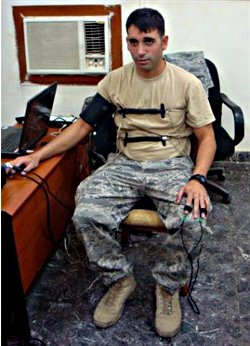
Tubes strapped across the chest, sensors clipped to the fingertips and an inflated blood pressure cuff attached to the upper arm; all the while needles scratch on a roll of paper as an examiner grills his or her subject with a series of questions.

The needles and paper of the polygraph have been replaced by computer monitors, and soon the polygraph itself may be replaced.

Researchers at the Defense Academy for Credibility Assessment at Fort Jackson are studying new devices to replace the polygraph in a variety of situations — Soldiers in Baghdad investigating an IED explosion, Homeland Security officials screening potential terrorists at airports or FBI agents searching for a kidnap victim.

Read more

Massachusetts Police Officers May Be Forced to Take Lie Detector Tests

Massachusetts’ Supreme Judicial Court has ruled that law enforcement officers in the state can be compelled to submit to lie detector “testing” in the course of internal investigations. John R. Ellement reports for the Boston Globe: BOSTON — Saying public confidence in law enforcement must be protected, the state’s high court today ruled that police … Read more

The Port-A-Poly Goes to Afghanistan: Fort Jackson Leader Reports Fielding of New Hand-Held Lie Detector

Some two weeks after MSNBC investigative reporter Bill Dedman broke the story of the Department of Defense’s new hand-held lie detector, formally dubbed the “Preliminary Credibility Assessment Screening System” (PCASS), Mike A. Glasch who writes for the weekly Reader, the official newspaper of Fort Jackson, South Carolina, picked up on the story in the 24 … Read more