Polygraph countermeasures are techniques for passing or beating a polygraph “test.” Publicly, polygraph operators claim that polygraph countermeasures are ineffective and that they can easily detect them. But documents provided to AntiPolygraph.org reveal that behind closed doors, they admit that countermeasures can indeed be effective and that they are difficult to detect.
The most informative of these is by Mark D. Handler, who at the time of writing is the American Association of Police Polygraphists’ Research & Information Chairman. In 2009, Handler gave a PowerPoint presentation (55 mb PDF | 19 mb PPT) to the Kentucky Polygraph Association titled “Countermeasures: What every examiner should know.” According to the file’s metadata,1 it was created by Captain (then Lieutenant) Walt Goodson of the Texas Department of Public Safety, who at the time of writing is the American Polygraph Association’s Vice-President for law enforcement matters and has served as director of the Texas Department of Public Safety Law Enforcement Polygraph School.
In addition to Goodson, Handler thanks Professor Charles R. Honts of Boise State University (who has conducted peer-reviewed research into polygraph countermeasures), Raymond Nelson of the Lafayette Instrument Company, who at the time of writing is also a director of the American Polygraph Association, and Charles E. Slupski, a former instructor at the Department of Defense Polygraph Institute who now runs the American International Institute of Polygraph and who, at the time of writing, is the American Polygraph Association’s President-Elect.
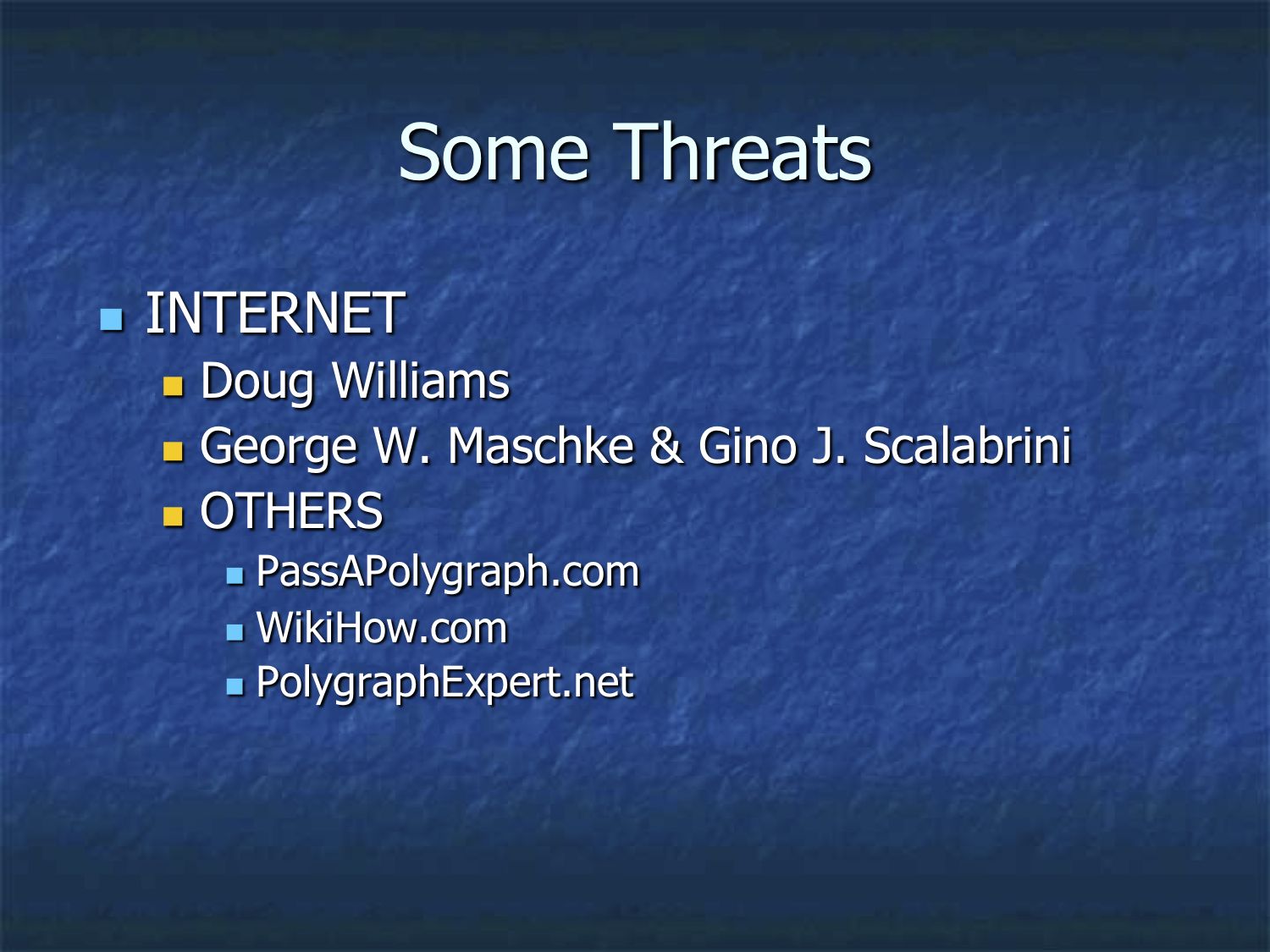
In his presentation, Handler characterizes sources of polygraph countermeasure information, including AntiPolygraph.org co-founders George Maschke and Gino Scalabrini, as “threats” (slide 26):
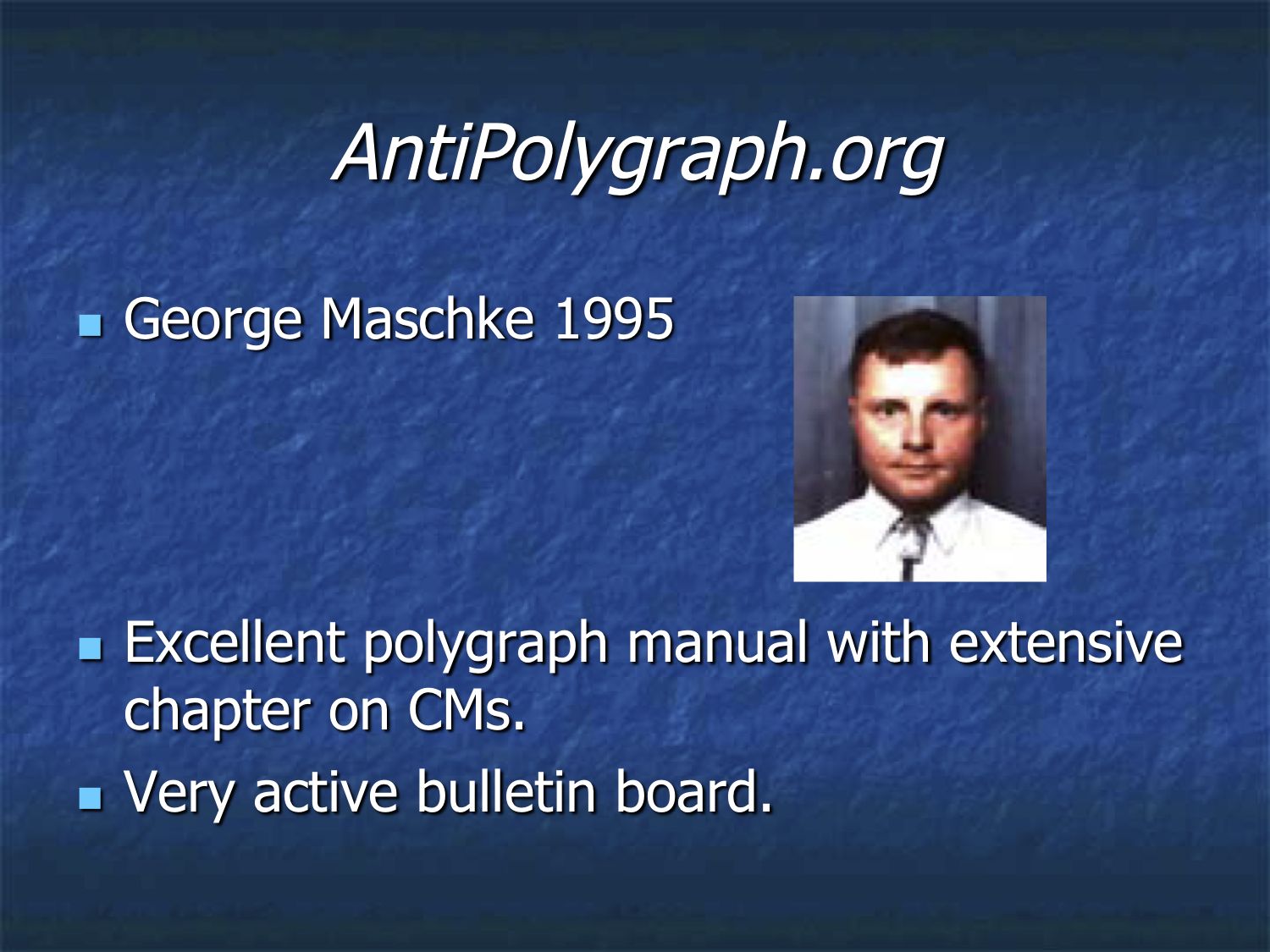
Discussion of AntiPolygraph.org begins at slide 67 and continues to slide 94. The presentation characterizes AntiPolygraph.org’s free book, The Lie Behind the Lie Detector (1 mb PDF), as an “[e]xcellent polygraph manual with extensive chapter on CMs [countermeasures]:
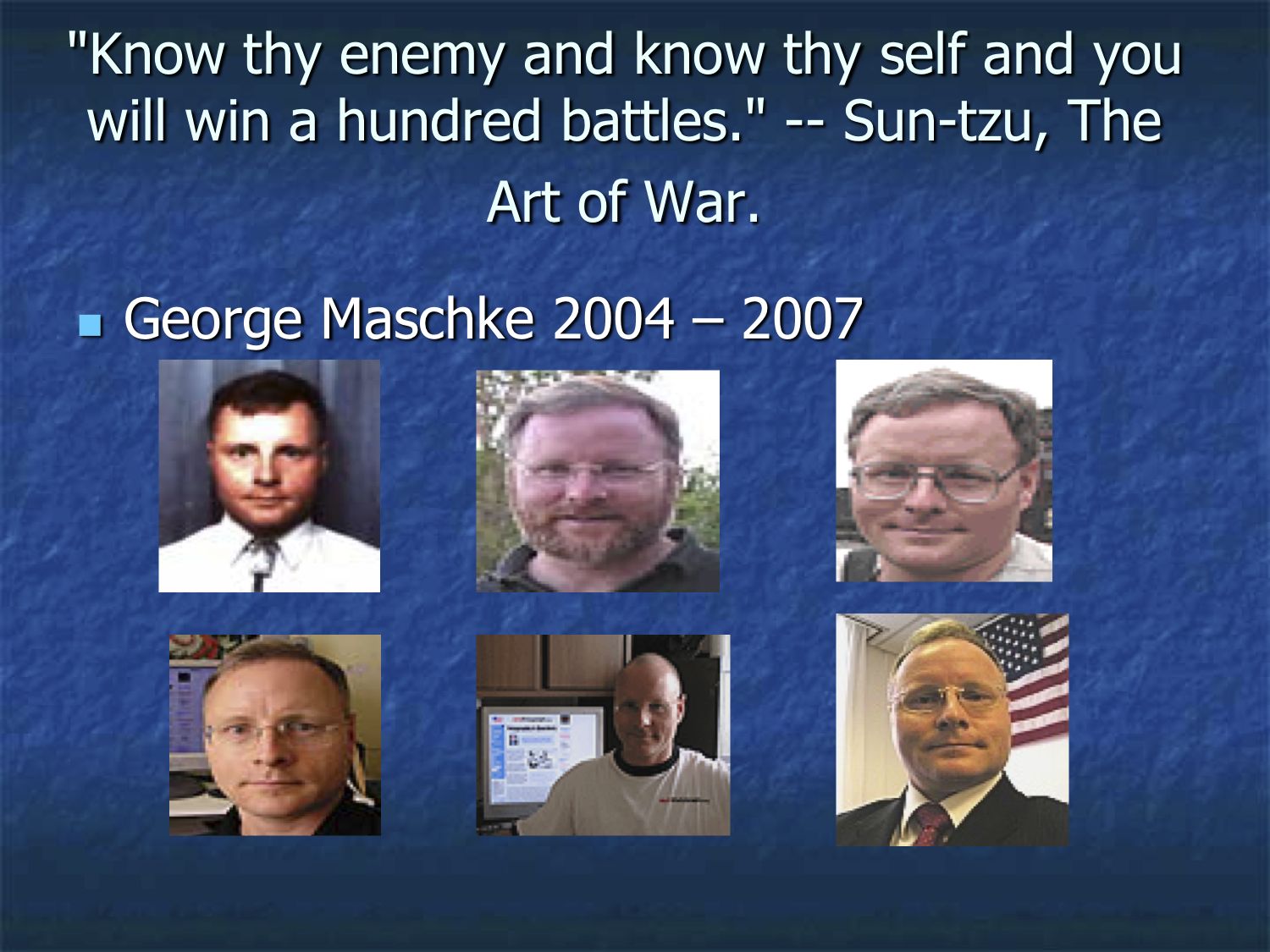
 Slide 68 shows six photographs of AntiPolygraph.org co-founder George Maschke under a quote from Sun Tsu, “Know thy enemy and know thyself and you will win a hundred battles”:
A biographical sketch follows, which appears to be based on Maschke’s public statement, “Too Hot of a Potato: A Citizen-Soldier’s Encounter with the Polygraph.” Slide 97 acknowledges that AntiPolygraph.org’s book provides “accurate information about how polygraph tests work and about possible countermeasures”:
Handler attempts to show that merely providing information about polygraphy to examinees has no effect on accuracy and cites several laboratory studies in support of that view.2 However, it should be borne in mind that such studies were conducted in situations where the examinees had very little incentive to apply themselves to the task of mastering polygraph countermeasures.3
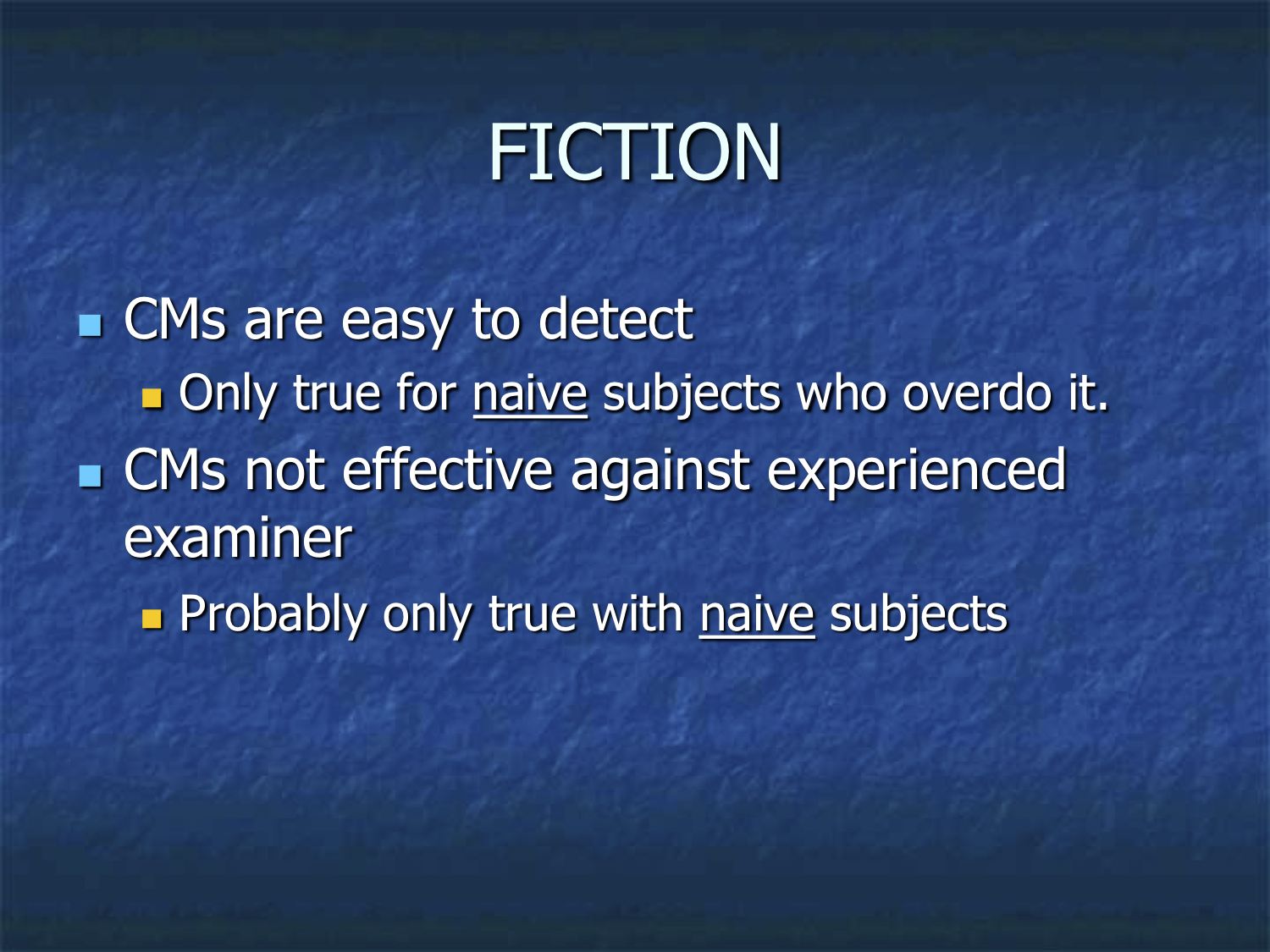
Contradicting the public proclamations of numerous polygraph operators, Handler characterizes as “fiction” the notions that “[countermeasures] are easy to detect” and that “countermeasures are not effective against [an] experienced examiner” (slide 104):
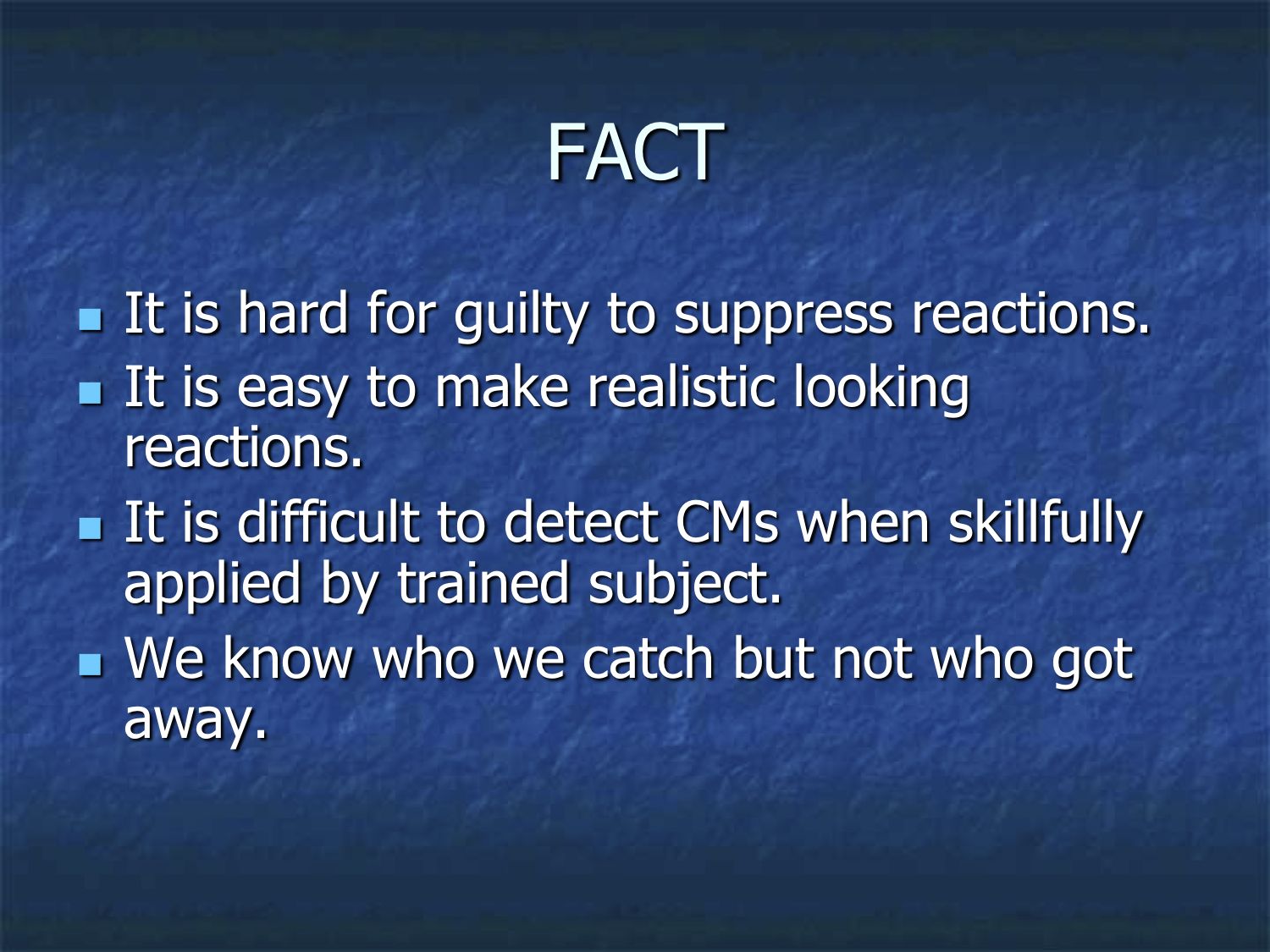
Handler also states it to be a “fact” that “[i]t is easy to make realistic reactions” and that “[i]t is difficult to detect [countermeasures] when skillfully applied by trained subjects” (slide 105):
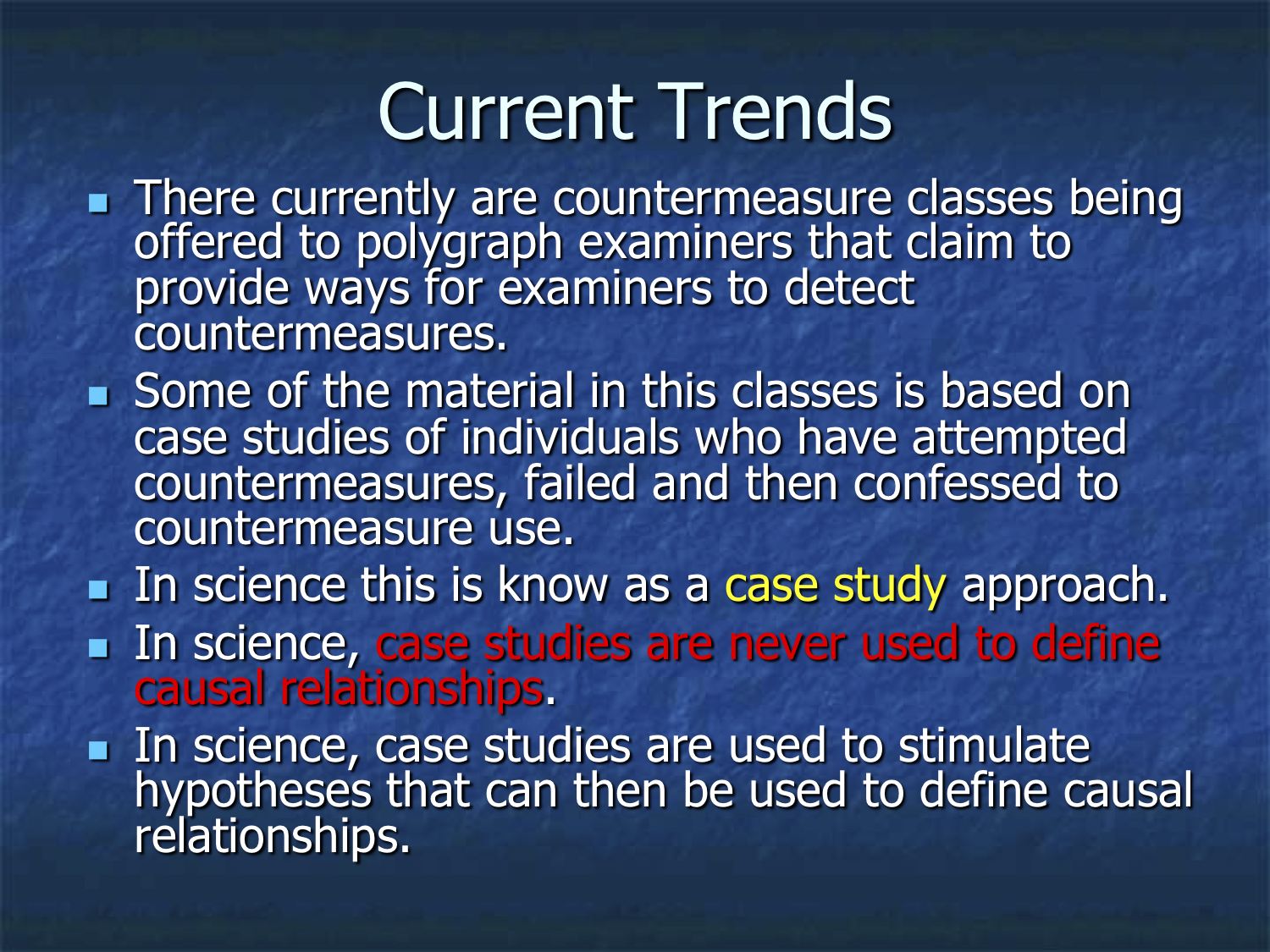
Dismissing countermeasure classes that purport to “provide ways for examiners to detect countermeasures,” Handler notes that they are inappropriately based on a “case study approach” (slide 110):
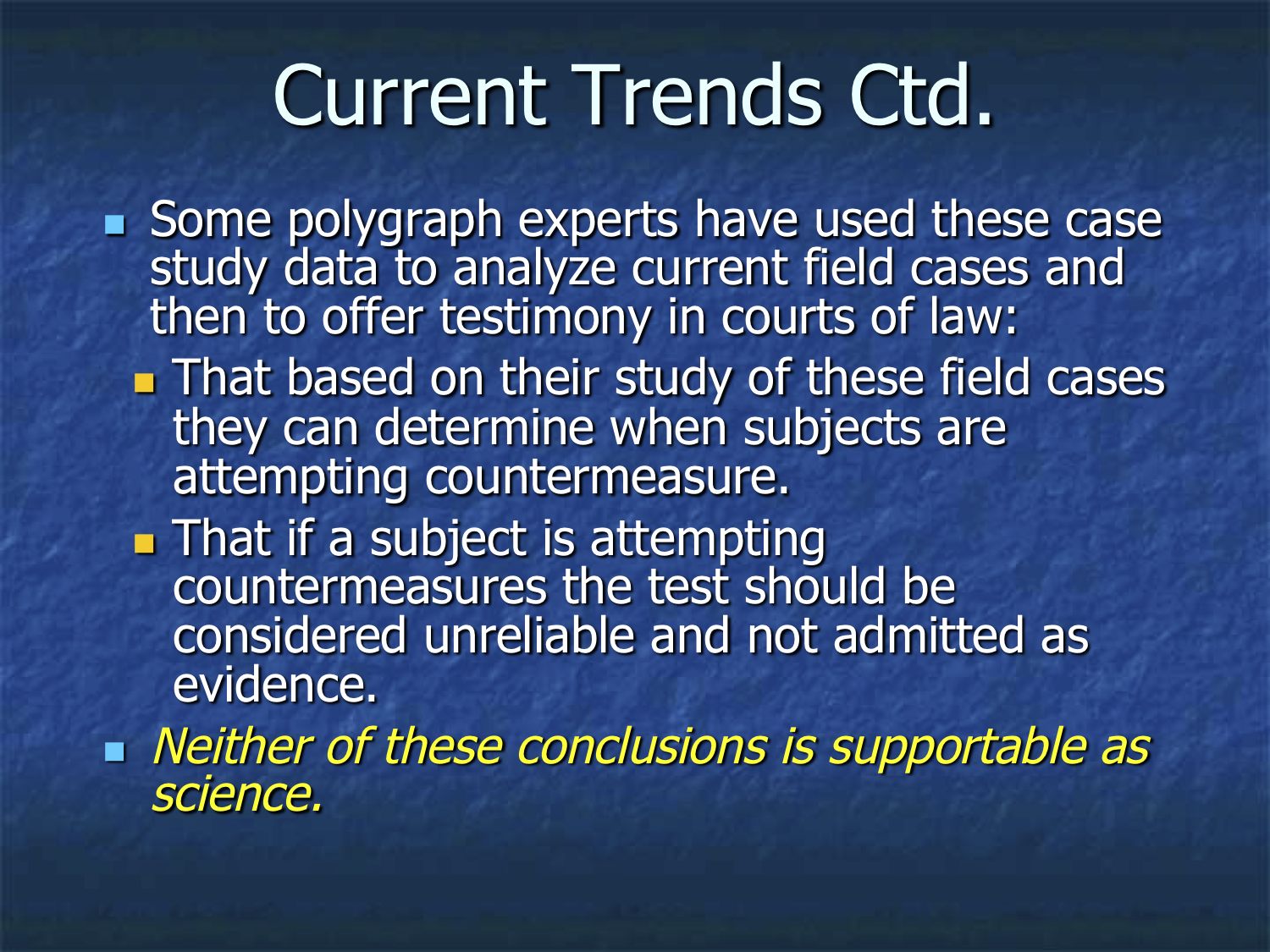
Handler observes that some polygraph “experts” have claimed based on case study data that they “can determine when subjects are attempting countermeasure[s]” and that “if a subject is attempting countermeasures the test should be considered unreliable and not admitted as evidence”4 (slide 113):
Handler further notes that “[n]o published scientific study shows that [sic] any person to be better than chance at detecting countermeasures, either from watching the subject or from analyzing the charts.” (Slide 114):5
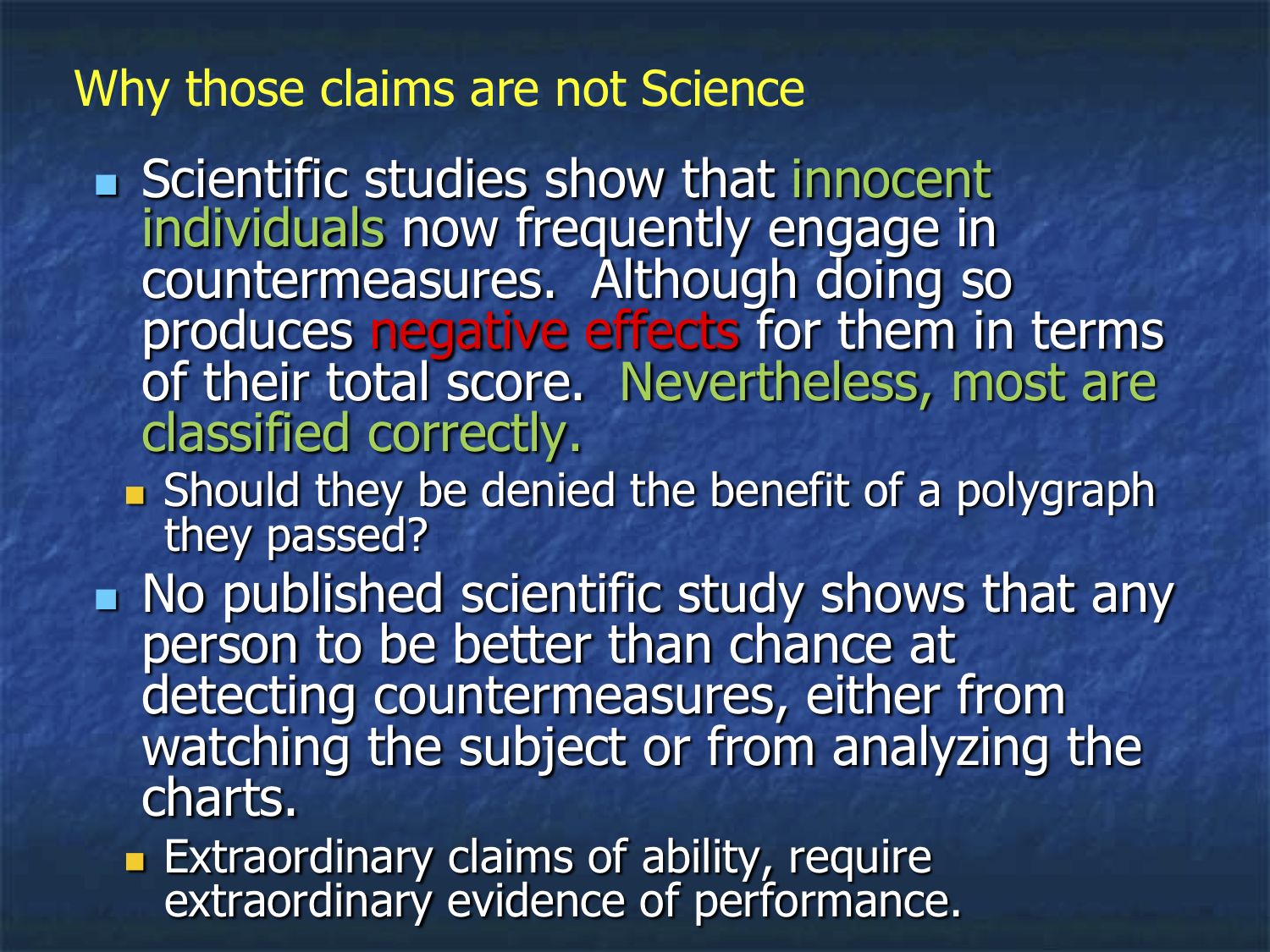
Paraphrasing Carl Sagan, Handler concludes, “Extraordinary claims of ability, require extraordinary evidence of performance.” Who can argue with that?
- In the PPT file’s properties, the author is cited as “WG08186.” A Google search on this term leads to Walt Goodson’s member page on the American Polygraph Association website. [↩]
- Cited studies include:
Rovner, L.I. (1979). The effects of information and practice on the accuracy of physiological detection of deception. Dissertation Abstracts International. (University Microfilm # AAD80-05308)
Rovner, L.I. (1986). The accuracy of physiological detection of deception for subjects with prior knowledge. Polygraph, 15, 1-39.
Honts, C. R. & Alloway, W. (2007). Information does not affect the validity of a comparison
question test. Legal And Criminological Psychology, 12, 311-312. (Erroneously cited as “Alloway & Honts, 2002”) [↩] - In this regard see, Iacono, W.G. “Effective Policing: Understanding How Polygraph Tests Work and Are Used,” Criminal Justice and Behavior, Vol. 35, No. 10, pp. 1295-1308 at pp. 1301-2:
COUNTERMEASURES
Honts and colleagues have published compelling findings showing that guilty individuals can readily defeat a CQT when briefly instructed how to do so (Honts, Devitt, Winbush, & Kircher, 1996; Honts, Hodes, & Raskin, 1985). This can be accomplished by covertly enhancing the response to control questions (e.g., by engaging in mental arithmetic when these questions are asked or lightly biting the tongue), and these covernt maneuvers are undetectable. Moreover, although the CQT is ideally administered in a manner that makes it difficult to readily identify control questions, anyone who wishes to can easily find out how to identify controls by accessing articles such as this one or Web sites such as www.antipolygraph.org. Nevertheless, these practicing scientists have concluded that the possible use of countermeasures is of no consequence in real life CQTs because those undergoing CQTs cannot figure out on their own how to use them to advantage (e.g., Honts & Alloway, 2007). It Honts and Alloway (2007), this conclusion was reached by testing undergraduates who were asked to steal movie-pass vouchers. A total of 10 individuals in the guilty condition were asked to read a 220-page book containing information regarding how to beat a CQT, and if they were successful, they were to receive theatre passes as a bonus. One can reasonably ask how this motivational manipulation might compare to the motivation criminals have to learn to beat a CQT. The former involves working hard for a possible but trivial reward of movie tickets, the latter involves trying to avoid incarceration. Considered from this perspective, it is perhaps not surprising that only seven guilty subjects admitted trying to use countermeasures, and only two beat the CQT. [↩] - Polygraph results should never be admitted as evidence in a court of law or equity, as polygraphy is completely without scientific basis. [↩]
- The first point in the slide, asserting that countermeasures used by innocent persons “produces negative effects for them in terms of their total score,” is evidently a reference to Honts, C.R., Amato, S.L, and Gordon, A.K., “Effects of Spontaneous Countermeasures Used Against the Comparison Question Test,” Polygraph, vol. 30, no. 1, 2001, pp. 1-9.
This study, published in the non-peer-reviewed trade journal of the American Polygraph Association, examined so-called “spontaneous” countermeasures attempts, that is, attempts to alter outcomes by people who have not been educated or trained in polygraph procedure and countermeasures. It is hardly surprising that countermeasure attempts by people who don’t know what they’re doing might be counterproductive. [↩]
The polygraph industry has more to worry about than just Antipolygraph.org & Doug Williams. We have and continue to use our own custom methods to defeat any interrogation device. We defeat it by implementing cross group methods, to individuals that face polygraphs, voice stress, or even just an interrogation. As your information portrays a trained subject can and will defeat these posers that present their craft as a valid way to check veracity. It is great to see validation of what we know to be the truth about the useless polygraph. We are sure the polygraph industry can’t be pleased right now, with the release of this powerpoint. Then again our group really doesn’t care what they think. For the record we have 100’s of people that have passed from our training. Good job on posting this, George Mashke. We approve. ** FREE THINK UNDERGROUD **
I recently failed a polygraph accused of using countermeasers. Does medical conditions such as 2cd stage COPD lung disease affect the polygraph?
William Demory Gillette – You may have “failed” the polygraph because the polygraph examiner was not getting the results he wanted. Look at it like this, who pays the polygraphist, and what results does his employer want?
An obvious fall back for a polygraphist is to blame the examinee when the polygraphist doesn’t get the results he is ordered to get. How can anyone possibly prove or disprove countermeasures were or were not being used?
I know as an absolute fact that CVSA analysts are taught how to get the “findings” that management requests.