- Welcome to AntiPolygraph.org Message Board.

A forum for free and open discussion of polygraph-related topics
Posted by Olly Otten
- Dec 21, 2008, 03:09 PMF. Lee Bailey was a pioneer in the use of polygraphs for legal defense, and was an avid supporter of their use, a stong believer in the science of polygraphs. and would make an excellent choice for keynote speaker for such an event. There is a much larger story regarding his disbarment, simplified, he was paid in stocks to defend someone, and then much later the court ordered him to surrender his stocks (payment), which he refused. (Would you give back your last several paychecks if your employer was found guilty of something?) Think about it.
There are two sides to everything.
There are two sides to everything.
Posted by Lethe
- Jul 24, 2008, 04:19 PMHuh? They're going to "make sure it [a polygraph result] is Amissible in Court"? Uh... being that amissible means "liable to be lost" that doesn't make any sense. Why would they want to lose polygraph results in court? That would be--oh, wait. No, they must mean admissible: capable or worthy of being admitted. Yeah, that would make sense. Add another [sic] there George!
Though, to be fair to the APA, the mistake may have been made by Gordon Vaughan--but they still should have caught it. Good grief, two clear error in three sentences. Way to do go APA! Now you're not just crapping up our society, you're crapping up our language too!
Anyway, no surprise that they're getting Bailey to come: he's their sort of scum.
Though, to be fair to the APA, the mistake may have been made by Gordon Vaughan--but they still should have caught it. Good grief, two clear error in three sentences. Way to do go APA! Now you're not just crapping up our society, you're crapping up our language too!
Anyway, no surprise that they're getting Bailey to come: he's their sort of scum.
Posted by George W. Maschke
- Jul 24, 2008, 04:10 AM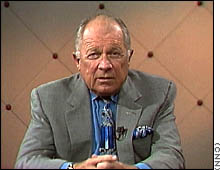
Disbarred attorney F. Lee Bailey
On 23 July 2008, the American Polygraph Association (APA) posted -- without shame or embarrassment -- the following announcement:
QuoteFamed Attorney, F. Lee Bailey to speak at APA seminar
Famed attorney, F. LEE Bailey is schedule [sic] to be the featured banquet speaker at the upcoming APA seminar to be held in Indianapolis, IN. Attorney Bailey will also lecture with APA General Counsel, Gordon Vaughan, during a session on Thursday, "Confessions to a Polygraph Examiner: How to make sure it is Amissible in Court. "
You can find out more about the topics and speakers when you check out the updated schedule which has now been posted.
What the APA fails to mention is that "(o)n November 21, 2001, the Supreme Court of Florida disbarred attorney F. Lee Bailey for 'multiple counts of egregious misconduct, including offering false testimony, engaging in ex parte communications, violating a client's confidences, violating two federal court orders, and trust account violations, including commingling and misappropriation.' Florida Bar v. Bailey, 803 So. 2d 683, 694 (Fla. 2001), cert. denied, 535 U.S. 1056 (2002) (Bailey)" (emphasis added). In 2002, Bailey was reciprocally disbarred in the state of Massachusetts.
In 1996, Bailey spent six weeks in federal prison for contempt of court. He was found guilty of contempt a second time in 2000 but spared a prison sentence.
Bailey, a long-time advocate of polygraphy, in the 1980s co-hosted with polygrapher Edward I. Gelb of Los Angeles a television show called Lie Detector. Gelb, a past president of the APA, is cut from the same ethical cloth as Bailey: he has for years falsely passed himself off as a Ph.D. in marketing his polygraph services (and the APA doesn't consider his fakery to be a violation of its ethical standards).