- Welcome to AntiPolygraph.org Message Board.

A forum for free and open discussion of polygraph-related topics
Recent posts
#21
CVSA and other Voice Stress Analysis Applications / Re: www.cvsaexposed.com
Last post by George W. Maschke - Jan 15, 2026, 01:30 PMArthur Herring's site was nitvcvsaexposed.com, which is no longer online. The site that rick walters mentions is something different.
#22
CVSA and other Voice Stress Analysis Applications / Re: www.cvsaexposed.com
Last post by Anthony R - Jan 15, 2026, 11:07 AMI think you are referring to the site Arthur Herring started when he was fighting against Charles Humble and NITV. Herring pointed out several facts about Humble, such as having a fake Ph.D, and using fake research to push his inaccurate gadget.
#23
Polygraph Procedure / Re: I saw my polygrapher at a ...
Last post by George W. Maschke - Jan 14, 2026, 03:15 AMI never saw my polygrapher (the late FBI special agent Jack Trimarco) in public after he wrongly branded me as a liar, but I did see him numerous times on television. After he retired, he went on to perform polygraph examinations for the now discontinued Dr. Phil show.
Had I met him again in person, I would have liked to have had a conversation with him. I never wished him any physical harm.
Had I met him again in person, I would have liked to have had a conversation with him. I never wished him any physical harm.
#24
Polygraph Procedure / I saw my polygrapher at a bar,...
Last post by smitty485 - Jan 13, 2026, 05:01 PMI had a horrible polygraph experience about a year ago and just recently ran into my polygrapher at a bar. He was pretty wasted. I didn't say anything and I don't even know if he recognized me, but it was him for sure. That asshole caused me to lose my job. I thought about smashing a bottle over his head. Anyone else ever see your polygrapher in public?
#25
CVSA and other Voice Stress Analysis Applications / www.cvsaexposed.com
Last post by rick walters - Jan 12, 2026, 10:29 AMThere is a new site that appeared on the net regarding NITV Federal Services LLC. www.cvsaexposed.com
Source is the Florida Accountability Coalition. Even checking from the Chicagoland area this organization does not exist in any FL official record for a Profit or Non Profit companies.
Checking domain records show www.cvsaexposed was created back in December 2025 and from the general area of Norristown, PA.
Source is the Florida Accountability Coalition. Even checking from the Chicagoland area this organization does not exist in any FL official record for a Profit or Non Profit companies.
Checking domain records show www.cvsaexposed was created back in December 2025 and from the general area of Norristown, PA.
#26
Polygraph Policy / Death of Aldrich Ames
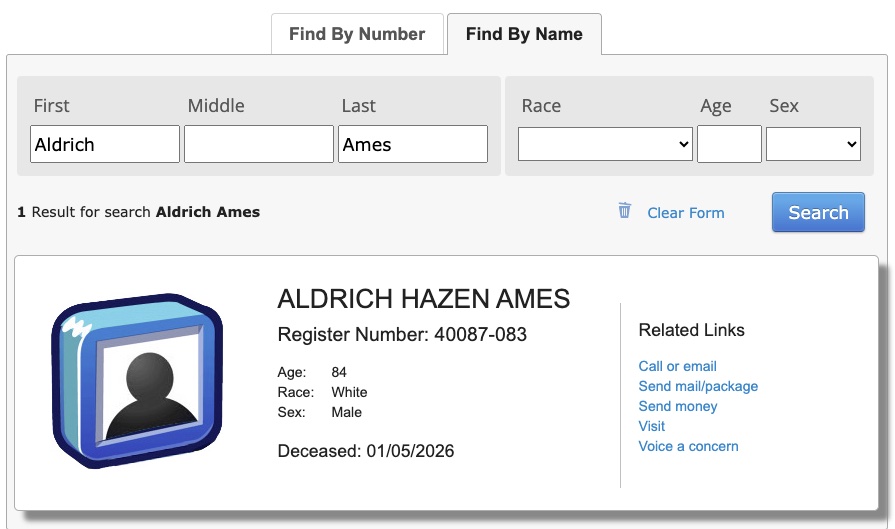
Last post by George W. Maschke - Jan 07, 2026, 05:36 AMTim Weiner reports for the New York Times that polygraph-beating CIA turncoat Aldrich Ames has died. Weiner, in a tendentious obituary (he characterizes Ames as "murderous" although he murdered no one), mentions that Ames failed polygraphs used to assess his credibility following his conviction, but doesn't mention the CIA polygraphs he passed while spying for the Soviet Union and Russia. Excerpt:
The Bureau of Prisons' "Inmate Locator" service indicates that Ames died on 5 January 2026:
Quotehttps://www.nytimes.com/2026/01/06/obituaries/aldrich-ames-dead.html
Aldrich Ames, the most murderous turncoat in the history of the Central Intelligence Agency, whose betrayal in working for the Soviet Union went undetected for almost a decade, died on Monday. He was 84 and had been a federal prisoner, serving life without parole, since 1994.
The death was recorded in the federal Bureau of Prisons inmate database. A spokesman said he died at the Federal Correctional Institution in Cumberland, Md.
...
A damage assessment by C.I.A. and F.B.I. officials never got to the bottom of the case. Mr. Ames, his memory damaged by alcohol, could not recall the scope of the secrets he sold. And he failed the polygraphs, or lie-detector tests, they gave him, leaving them in doubt as they assayed a decade of deception and destruction.
...
The Bureau of Prisons' "Inmate Locator" service indicates that Ames died on 5 January 2026:
#27
Polygraph Policy / Re: DIA's Insider Threat Progr...
Last post by John M. - Jan 06, 2026, 02:06 PM4. Whether an agency that categorically refuses to consider disability-based accommodations or to engage in the interactive process required by 29 C.F.R. §1630.2(o)(3) may nevertheless be deemed to have acted lawfully under the Rehabilitation Act when its justifications are shifting, medically unsupported, and contrary to its own binding regulations.
A federal agency that categorically refuses to consider disability-based accommodations or to engage in the interactive process required by 29 C.F.R. § 1630.2(o)(3) (incorporated into the Rehabilitation Act via EEOC regulations) may not be deemed to have acted lawfully, particularly when its justifications are shifting, medically unsupported, and contrary to its own binding regulations.
Core Obligations Under the Rehabilitation Act and EEOC Regulations.
The Rehabilitation Act (Section 501) adopts the standards of the Americans with Disabilities Act (ADA), requiring federal agencies to provide reasonable accommodations to qualified individuals with disabilities unless doing so would cause undue hardship. A key component is the interactive process: an informal, good-faith dialogue between the agency and the employee to identify effective accommodations (EEOC Enforcement Guidance on Reasonable Accommodation and Undue Hardship Under the ADA, as applied to the Rehabilitation Act).
• Categorical refusal to consider accommodations or engage interactively is a per se violation. The EEOC has repeatedly held that failing to participate in the interactive process—e.g., ignoring requests, denying without exploration, or blanket policies against certain accommodations—constitutes discrimination, even if an accommodation might ultimately cause undue hardship.
• Agencies must respond expeditiously and in good faith. An outright refusal breaks the process and violates the Act.
Impact of Flawed Justifications
• Shifting justifications: Inconsistent or changing reasons for denial (e.g., initially citing one policy, later another) raise an inference of pretext (EEOC Enforcement Guidance on Retaliation and Related Issues, applicable here via overlapping standards). This undermines claims of legitimate nondiscriminatory reasons, such as undue hardship or business necessity.
• Medically unsupported reasons: Denials must be based on individualized assessments, often requiring medical documentation review. Unsupported assertions (e.g., ignoring provided medical evidence or relying on unsubstantiated assumptions about a condition) fail to meet the interactive process requirement and may evidence bad faith or discrimination.
• Contrary to binding regulations: Federal agencies must follow their own mandatory internal rules (e.g., DoD instructions or agency-specific procedures under Executive Order 13164). Disregarding them in accommodation decisions supports findings of arbitrary action or violation of the Act, as procedural noncompliance is reviewable even in sensitive contexts.
Practical and Legal Outcomes
The EEOC and courts view such conduct as evidence of failure to accommodate, potentially leading to liability. Good-faith engagement is required; categorical policies or flawed rationales do not shield agencies. National security or undue hardship defenses must be substantiated individually, not applied blanketly.
In summary, categorical refusal combined with shifting, unsupported, or regulation-contrary justifications strongly indicates unlawful conduct under the Rehabilitation Act. Employees can challenge this via the agency's EEO process or EEOC.
A federal agency that categorically refuses to consider disability-based accommodations or to engage in the interactive process required by 29 C.F.R. § 1630.2(o)(3) (incorporated into the Rehabilitation Act via EEOC regulations) may not be deemed to have acted lawfully, particularly when its justifications are shifting, medically unsupported, and contrary to its own binding regulations.
Core Obligations Under the Rehabilitation Act and EEOC Regulations.
The Rehabilitation Act (Section 501) adopts the standards of the Americans with Disabilities Act (ADA), requiring federal agencies to provide reasonable accommodations to qualified individuals with disabilities unless doing so would cause undue hardship. A key component is the interactive process: an informal, good-faith dialogue between the agency and the employee to identify effective accommodations (EEOC Enforcement Guidance on Reasonable Accommodation and Undue Hardship Under the ADA, as applied to the Rehabilitation Act).
• Categorical refusal to consider accommodations or engage interactively is a per se violation. The EEOC has repeatedly held that failing to participate in the interactive process—e.g., ignoring requests, denying without exploration, or blanket policies against certain accommodations—constitutes discrimination, even if an accommodation might ultimately cause undue hardship.
• Agencies must respond expeditiously and in good faith. An outright refusal breaks the process and violates the Act.
Impact of Flawed Justifications
• Shifting justifications: Inconsistent or changing reasons for denial (e.g., initially citing one policy, later another) raise an inference of pretext (EEOC Enforcement Guidance on Retaliation and Related Issues, applicable here via overlapping standards). This undermines claims of legitimate nondiscriminatory reasons, such as undue hardship or business necessity.
• Medically unsupported reasons: Denials must be based on individualized assessments, often requiring medical documentation review. Unsupported assertions (e.g., ignoring provided medical evidence or relying on unsubstantiated assumptions about a condition) fail to meet the interactive process requirement and may evidence bad faith or discrimination.
• Contrary to binding regulations: Federal agencies must follow their own mandatory internal rules (e.g., DoD instructions or agency-specific procedures under Executive Order 13164). Disregarding them in accommodation decisions supports findings of arbitrary action or violation of the Act, as procedural noncompliance is reviewable even in sensitive contexts.
Practical and Legal Outcomes
The EEOC and courts view such conduct as evidence of failure to accommodate, potentially leading to liability. Good-faith engagement is required; categorical policies or flawed rationales do not shield agencies. National security or undue hardship defenses must be substantiated individually, not applied blanketly.
In summary, categorical refusal combined with shifting, unsupported, or regulation-contrary justifications strongly indicates unlawful conduct under the Rehabilitation Act. Employees can challenge this via the agency's EEO process or EEOC.
#28
Polygraph Policy / Re: DIA's Insider Threat Progr...
Last post by John M. - Jan 06, 2026, 02:02 PM3. Whether courts may extend Department of the Navy v. Egan, 484 U.S. 518 (1988), beyond clearance adjudications to cover ordinary personnel and medical accommodation decisions, effectively placing federal employees' statutory rights outside judicial review even when no security clearance has been suspended, revoked, or unfavorably adjudicated.
Courts generally may not broadly extend Department of the Navy v. Egan, 484 U.S. 518 (1988), beyond the merits of security clearance adjudications (grants, denials, or revocations) to shield ordinary personnel actions or medical/reasonable accommodation decisions from judicial review under the Rehabilitation Act, particularly where no clearance has been suspended, revoked, or unfavorably adjudicated.
Core Scope of Egan
Egan held that the Merit Systems Protection Board (and by extension, courts) lacks authority to review the substantive merits of a security clearance determination absent clear congressional authorization. This stems from the President's constitutional authority over national security and the predictive nature of clearance judgments (e.g., trustworthiness and risk assessment). Courts extend this to bar review of discrimination claims (including under Title VII or the Rehabilitation Act) only if resolving them requires second-guessing the executive's predictive security judgment (e.g., cases like Ryan v. Reno (D.C. Cir. 1999) and recent reaffirmations in Lee v. Garland (D.C. Cir. 2024)).
However, Egan is narrow:
• It does not create absolute immunity for all security-related actions.
• Lower courts consistently refuse to extend it to non-clearance decisions or procedural/discrimination challenges that do not probe the merits of a clearance adjudication.
Application to Ordinary Personnel and Accommodation Decisions
• No extension to reasonable accommodation claims: Where an action involves failure to accommodate a disability (e.g., alternative screening, reassignment, or waivers) without involving a formal clearance revocation/denial, courts review Rehabilitation Act claims. For instance, in Sanchez v. U.S. Dep't of Energy (10th Cir. 2018), the court reviewed a failure-to-accommodate claim despite security concerns, distinguishing it from Egan's bar on clearance merits.
• Personnel actions not tied to clearance adjudication: Courts review discrimination or accommodation claims in security-sensitive roles if they target procedural violations, interactive process failures, or pretext, without requiring review of a predictive clearance judgment (e.g., challenges to reassignment denials or medical deferrals).
• No clearance action involved: If no clearance has been adversely adjudicated (e.g., polygraph unsuitability leading to accommodation denial without revocation), Egan does not apply. Courts reject broad invocations to evade statutory duties under the Rehabilitation Act, which requires interactive engagement and accommodations unless undue hardship (including legitimate security risks) is proven.
Limits and Exceptions
• National security can justify "undue hardship" denials of accommodation, and courts defer to agency judgments on risks.
• If a claim inescapably requires evaluating why a clearance was (or would be) denied/revoked, Egan bars review—even for constitutional or discrimination allegations in some circuits.
• Procedural compliance (e.g., following internal rules) remains reviewable.
In summary, Egan protects the executive's core discretion over clearance merits but does not blanket ordinary personnel or accommodation decisions—especially absent any clearance adjudication—from Rehabilitation Act scrutiny. Courts police overextensions to preserve statutory rights.
Courts generally may not broadly extend Department of the Navy v. Egan, 484 U.S. 518 (1988), beyond the merits of security clearance adjudications (grants, denials, or revocations) to shield ordinary personnel actions or medical/reasonable accommodation decisions from judicial review under the Rehabilitation Act, particularly where no clearance has been suspended, revoked, or unfavorably adjudicated.
Core Scope of Egan
Egan held that the Merit Systems Protection Board (and by extension, courts) lacks authority to review the substantive merits of a security clearance determination absent clear congressional authorization. This stems from the President's constitutional authority over national security and the predictive nature of clearance judgments (e.g., trustworthiness and risk assessment). Courts extend this to bar review of discrimination claims (including under Title VII or the Rehabilitation Act) only if resolving them requires second-guessing the executive's predictive security judgment (e.g., cases like Ryan v. Reno (D.C. Cir. 1999) and recent reaffirmations in Lee v. Garland (D.C. Cir. 2024)).
However, Egan is narrow:
• It does not create absolute immunity for all security-related actions.
• Lower courts consistently refuse to extend it to non-clearance decisions or procedural/discrimination challenges that do not probe the merits of a clearance adjudication.
Application to Ordinary Personnel and Accommodation Decisions
• No extension to reasonable accommodation claims: Where an action involves failure to accommodate a disability (e.g., alternative screening, reassignment, or waivers) without involving a formal clearance revocation/denial, courts review Rehabilitation Act claims. For instance, in Sanchez v. U.S. Dep't of Energy (10th Cir. 2018), the court reviewed a failure-to-accommodate claim despite security concerns, distinguishing it from Egan's bar on clearance merits.
• Personnel actions not tied to clearance adjudication: Courts review discrimination or accommodation claims in security-sensitive roles if they target procedural violations, interactive process failures, or pretext, without requiring review of a predictive clearance judgment (e.g., challenges to reassignment denials or medical deferrals).
• No clearance action involved: If no clearance has been adversely adjudicated (e.g., polygraph unsuitability leading to accommodation denial without revocation), Egan does not apply. Courts reject broad invocations to evade statutory duties under the Rehabilitation Act, which requires interactive engagement and accommodations unless undue hardship (including legitimate security risks) is proven.
Limits and Exceptions
• National security can justify "undue hardship" denials of accommodation, and courts defer to agency judgments on risks.
• If a claim inescapably requires evaluating why a clearance was (or would be) denied/revoked, Egan bars review—even for constitutional or discrimination allegations in some circuits.
• Procedural compliance (e.g., following internal rules) remains reviewable.
In summary, Egan protects the executive's core discretion over clearance merits but does not blanket ordinary personnel or accommodation decisions—especially absent any clearance adjudication—from Rehabilitation Act scrutiny. Courts police overextensions to preserve statutory rights.
#29
Polygraph Policy / Re: DIA's Insider Threat Progr...
Last post by John M. - Jan 06, 2026, 02:00 PM2. Whether mandatory Department of Defense regulations, including DoDI 5210.91—which (a) prohibit adverse administrative action based solely on an unresolved polygraph result and (b) require medical deferral or exemption for individuals who are psychologically or medically unsuited for testing—are judicially enforceable under the Rehabilitation Act, or instead may be disregarded under a theory of unreviewable "security discretion."
Mandatory Department of Defense (DoD) regulations in DoDI 5210.91 (Polygraph and Credibility Assessment Procedures) are generally judicially enforceable in the context of a Rehabilitation Act claim, and agencies may not disregard them under a broad theory of unreviewable "security discretion."
Core Holding from Department of the Navy v. Egan (1988)
The Supreme Court in Egan held that merits of security clearance decisions—including grants, denials, or revocations—are committed to executive discretion and generally not subject to judicial review. This protects predictive judgments about risks to national security. Courts have extended this to bar review of discrimination claims (including under Title VII or the Rehabilitation Act) when resolution requires second-guessing the substance of a clearance decision (e.g., recent cases like Lee v. DOJ (D.C. Cir. 2024), where revocation after failed polygraphs barred review of discrimination claims).
However, Egan does not create absolute immunity for all security-related actions. Courts may review claims alleging that an agency violated its own mandatory procedures or statutory obligations, particularly where the challenge targets procedural compliance rather than the predictive security judgment.
Application to DoDI 5210.91 Provisions
DoDI 5210.91 establishes binding procedures for DoD polygraph programs, including:
• Prohibition on adverse action based solely on unresolved polygraph results — Agencies must have additional supporting evidence or resolution before acting.
• Requirement for medical deferral or exemption — Examiners must postpone or exempt individuals deemed psychologically or medically unsuitable (e.g., conditions affecting physiological responses), often involving evaluation by medical authorities.
These are mandatory internal rules ("shall" language in the instruction), not discretionary guidelines.
In a Rehabilitation Act context:
• If an agency ignores these provisions—e.g., taking adverse action solely on an inconclusive polygraph or refusing a required medical deferral/exemption for a documented disability—an employee can argue this violates the duty to engage in the interactive process or provide reasonable accommodation (e.g., alternative assessment methods, waiver, or reassignment).
• Such a claim challenges procedural noncompliance with DoD's own binding regulations, not the merits of whether the employee poses a security risk.
• Courts and the EEOC routinely review whether agencies followed their own rules in discrimination cases, even in security-sensitive contexts, as long as the inquiry does not probe the substantive clearance judgment.
Limits of "Unreviewable Security Discretion"
Agencies cannot invoke "security discretion" to disregard mandatory regulations. While broad deference applies to ultimate clearance outcomes, procedural violations tied to anti-discrimination laws remain reviewable (e.g., via EEOC federal sector process or limited judicial review under the Administrative Procedure Act for arbitrary/capricious action). National security can justify "undue hardship" denials of accommodation, but it does not shield outright noncompliance with DoDI 5210.91.
Practical Outcomes
• No reported cases directly litigate these exact DoDI provisions under the Rehabilitation Act, but analogous challenges (e.g., failure to follow security regulations in discrimination claims) have proceeded past motions to dismiss where framed procedurally.
• Employees can raise noncompliance in EEO complaints, arguing it evidences failure to accommodate or pretext.
In summary, while security clearance merits are largely unreviewable, mandatory procedural protections in DoDI 5210.91 are enforceable in Rehabilitation Act claims challenging agency disregard of those rules. Outcomes turn on case specifics, such as how the polygraph interacts with the disability and job requirements.
Mandatory Department of Defense (DoD) regulations in DoDI 5210.91 (Polygraph and Credibility Assessment Procedures) are generally judicially enforceable in the context of a Rehabilitation Act claim, and agencies may not disregard them under a broad theory of unreviewable "security discretion."
Core Holding from Department of the Navy v. Egan (1988)
The Supreme Court in Egan held that merits of security clearance decisions—including grants, denials, or revocations—are committed to executive discretion and generally not subject to judicial review. This protects predictive judgments about risks to national security. Courts have extended this to bar review of discrimination claims (including under Title VII or the Rehabilitation Act) when resolution requires second-guessing the substance of a clearance decision (e.g., recent cases like Lee v. DOJ (D.C. Cir. 2024), where revocation after failed polygraphs barred review of discrimination claims).
However, Egan does not create absolute immunity for all security-related actions. Courts may review claims alleging that an agency violated its own mandatory procedures or statutory obligations, particularly where the challenge targets procedural compliance rather than the predictive security judgment.
Application to DoDI 5210.91 Provisions
DoDI 5210.91 establishes binding procedures for DoD polygraph programs, including:
• Prohibition on adverse action based solely on unresolved polygraph results — Agencies must have additional supporting evidence or resolution before acting.
• Requirement for medical deferral or exemption — Examiners must postpone or exempt individuals deemed psychologically or medically unsuitable (e.g., conditions affecting physiological responses), often involving evaluation by medical authorities.
These are mandatory internal rules ("shall" language in the instruction), not discretionary guidelines.
In a Rehabilitation Act context:
• If an agency ignores these provisions—e.g., taking adverse action solely on an inconclusive polygraph or refusing a required medical deferral/exemption for a documented disability—an employee can argue this violates the duty to engage in the interactive process or provide reasonable accommodation (e.g., alternative assessment methods, waiver, or reassignment).
• Such a claim challenges procedural noncompliance with DoD's own binding regulations, not the merits of whether the employee poses a security risk.
• Courts and the EEOC routinely review whether agencies followed their own rules in discrimination cases, even in security-sensitive contexts, as long as the inquiry does not probe the substantive clearance judgment.
Limits of "Unreviewable Security Discretion"
Agencies cannot invoke "security discretion" to disregard mandatory regulations. While broad deference applies to ultimate clearance outcomes, procedural violations tied to anti-discrimination laws remain reviewable (e.g., via EEOC federal sector process or limited judicial review under the Administrative Procedure Act for arbitrary/capricious action). National security can justify "undue hardship" denials of accommodation, but it does not shield outright noncompliance with DoDI 5210.91.
Practical Outcomes
• No reported cases directly litigate these exact DoDI provisions under the Rehabilitation Act, but analogous challenges (e.g., failure to follow security regulations in discrimination claims) have proceeded past motions to dismiss where framed procedurally.
• Employees can raise noncompliance in EEO complaints, arguing it evidences failure to accommodate or pretext.
In summary, while security clearance merits are largely unreviewable, mandatory procedural protections in DoDI 5210.91 are enforceable in Rehabilitation Act claims challenging agency disregard of those rules. Outcomes turn on case specifics, such as how the polygraph interacts with the disability and job requirements.
#30
Polygraph Policy / Re: DIA's Insider Threat Progr...
Last post by John M. - Jan 06, 2026, 01:56 PMI posed the four questions presented in my case to Grok, and this is what it came up with -
1. Whether a federal agency may, consistent with the Rehabilitation Act of 1973 and EEOC regulations, redefine a security screening requirement—such as a counterintelligence scope polygraph (CSP) examination—as an "essential job function," thereby eliminating the duty to provide reasonable accommodation to employees whose documented medical conditions render them unsuitable for such testing.
A federal agency generally may not redefine a security screening requirement—such as a counterintelligence scope polygraph (CSP) examination—as an "essential job function" solely to eliminate the duty to provide reasonable accommodation under the Rehabilitation Act of 1973 (Section 501) and EEOC regulations.
Key Principles Under the Rehabilitation Act and EEOC Guidance
The Rehabilitation Act prohibits federal agencies from discriminating against qualified individuals with disabilities and requires them to provide reasonable accommodations unless doing so would cause undue hardship. A "qualified individual" is one who can perform the essential functions of the job with or without reasonable accommodation (29 C.F.R. § 1630.2(m), incorporated into federal sector rules).
Essential functions are the fundamental duties of the position, not marginal ones. Factors for determining them include:
• The employer's judgment
• Written job descriptions
• Time spent performing the function
• Consequences of not requiring it
Courts and the EEOC defer to employer judgments on essential functions but scrutinize attempts to manipulate them to avoid accommodation obligations.
Application to Security Requirements Like CSP
Positions requiring access to classified information (e.g., in intelligence or defense agencies) often mandate security clearances, which include polygraph screenings like CSP for counterintelligence purposes. Holding or obtaining such a clearance is frequently considered a qualification standard or essential eligibility requirement for the role.
However:
• Agencies cannot arbitrarily relabel a screening requirement as "essential" to bypass the interactive process for reasonable accommodation.
• If a documented medical condition (e.g., certain anxiety disorders, heart conditions, or other impairments that affect physiological responses) renders an employee unsuitable for polygraph testing, the agency must explore accommodations—such as alternative screening methods, reassignment to a non-sensitive position, or waivers—if they would enable the individual to perform the job's core duties without undue hardship.
EEOC guidance emphasizes that medical examinations (including those that may interact with disabilities) must be job-related and consistent with business necessity. Polygraphs are not classified as medical examinations under the ADA/Rehabilitation Act, but if a disability prevents successful completion, the agency cannot simply declare the test itself "essential" without justification tied to the position's fundamental duties.
Relevant Considerations and Limitations
• National security exception: In roles involving sensitive classified information, courts often uphold denial of accommodations that compromise security (e.g., waiving a clearance requirement could pose a direct threat or fundamental alteration). Undue hardship in the federal context can include risks to national security.
• No direct precedent on CSP: There are no widely reported court cases specifically addressing CSP polygraphs and reasonable accommodation claims under the Rehabilitation Act. Analogous cases involving security clearances (e.g., Kaplan v. Northrop Grumman Corp. or EEOC v. Exxon) treat clearance as an essential requirement where core job duties involve protected information.
• Employee options: If denied accommodation, an employee may challenge the designation via the EEOC federal sector process, arguing the agency failed to engage interactively or that the polygraph is not truly essential.
In summary, while agencies have broad discretion to define essential functions—especially for security-sensitive roles—they cannot redefine requirements merely to evade accommodation duties. The determination must be based on legitimate job needs, and the interactive process is required. For specific situations, consult an attorney or file with the agency's EEO office/EEOC, as outcomes depend on case facts, job description, and agency mission.
1. Whether a federal agency may, consistent with the Rehabilitation Act of 1973 and EEOC regulations, redefine a security screening requirement—such as a counterintelligence scope polygraph (CSP) examination—as an "essential job function," thereby eliminating the duty to provide reasonable accommodation to employees whose documented medical conditions render them unsuitable for such testing.
A federal agency generally may not redefine a security screening requirement—such as a counterintelligence scope polygraph (CSP) examination—as an "essential job function" solely to eliminate the duty to provide reasonable accommodation under the Rehabilitation Act of 1973 (Section 501) and EEOC regulations.
Key Principles Under the Rehabilitation Act and EEOC Guidance
The Rehabilitation Act prohibits federal agencies from discriminating against qualified individuals with disabilities and requires them to provide reasonable accommodations unless doing so would cause undue hardship. A "qualified individual" is one who can perform the essential functions of the job with or without reasonable accommodation (29 C.F.R. § 1630.2(m), incorporated into federal sector rules).
Essential functions are the fundamental duties of the position, not marginal ones. Factors for determining them include:
• The employer's judgment
• Written job descriptions
• Time spent performing the function
• Consequences of not requiring it
Courts and the EEOC defer to employer judgments on essential functions but scrutinize attempts to manipulate them to avoid accommodation obligations.
Application to Security Requirements Like CSP
Positions requiring access to classified information (e.g., in intelligence or defense agencies) often mandate security clearances, which include polygraph screenings like CSP for counterintelligence purposes. Holding or obtaining such a clearance is frequently considered a qualification standard or essential eligibility requirement for the role.
However:
• Agencies cannot arbitrarily relabel a screening requirement as "essential" to bypass the interactive process for reasonable accommodation.
• If a documented medical condition (e.g., certain anxiety disorders, heart conditions, or other impairments that affect physiological responses) renders an employee unsuitable for polygraph testing, the agency must explore accommodations—such as alternative screening methods, reassignment to a non-sensitive position, or waivers—if they would enable the individual to perform the job's core duties without undue hardship.
EEOC guidance emphasizes that medical examinations (including those that may interact with disabilities) must be job-related and consistent with business necessity. Polygraphs are not classified as medical examinations under the ADA/Rehabilitation Act, but if a disability prevents successful completion, the agency cannot simply declare the test itself "essential" without justification tied to the position's fundamental duties.
Relevant Considerations and Limitations
• National security exception: In roles involving sensitive classified information, courts often uphold denial of accommodations that compromise security (e.g., waiving a clearance requirement could pose a direct threat or fundamental alteration). Undue hardship in the federal context can include risks to national security.
• No direct precedent on CSP: There are no widely reported court cases specifically addressing CSP polygraphs and reasonable accommodation claims under the Rehabilitation Act. Analogous cases involving security clearances (e.g., Kaplan v. Northrop Grumman Corp. or EEOC v. Exxon) treat clearance as an essential requirement where core job duties involve protected information.
• Employee options: If denied accommodation, an employee may challenge the designation via the EEOC federal sector process, arguing the agency failed to engage interactively or that the polygraph is not truly essential.
In summary, while agencies have broad discretion to define essential functions—especially for security-sensitive roles—they cannot redefine requirements merely to evade accommodation duties. The determination must be based on legitimate job needs, and the interactive process is required. For specific situations, consult an attorney or file with the agency's EEO office/EEOC, as outcomes depend on case facts, job description, and agency mission.