- Welcome to AntiPolygraph.org Message Board.

A forum for free and open discussion of polygraph-related topics
Posted by EosJupiter
- Jan 22, 2007, 03:02 AMQuote from: George W. Maschke on Jan 10, 2007, 05:37 AMA new edition of the federal polygraph handbook, formally titled the "Federal Psychophysiological Detection of Deception Examiner Handbook" and dated 2 October 2006, may be downloaded here:
http://antipolygraph.org/documents/federal-polygraph-handbook-02-10-2006.pdf
This edition includes a new section (Chapter 18) on countermeasures.
George,
Thanks for this fine addition to my polygraph information library. It will be put to good use. I found chapter 18 most interesting and hilarious. The funniest part being the MSD (Motion Sensor Devices). Of note is that nothing about the use of mental countermeasures is even mentioned or interpreted as being collectable. This speaks volumes. I consider this similar to fly fishing with an accordion. Makes alot of noise, but nothing is caught. The other important thing is the attempt by the polygrapher to mask and be non-accusatory if a subject has polygraph knowlege. Like anyone of consequence and audacity would cough up that information. Its great to have the opponents play book. The other thing to note is that any credits in the bibliography are extremely dated, 1999 being the newest data published. And a majority of the works cited are just polygrapher studies for polygraphers . Nothing notable or of any scientific validity. If this is the best they got, then DODPI truly does live up to the trade school accreditation.
Regards .....
Posted by LieBabyCryBaby
- Jan 10, 2007, 12:54 PMYes, thanks, George. Now I can alternate between The Lie Behind the Lie Detector and this Federal PDD Examiner Handbook to help with my occasional insomnia. 
Posted by George W. Maschke
- Jan 10, 2007, 05:37 AMA new edition of the federal polygraph handbook, formally titled the "Federal Psychophysiological Detection of Deception Examiner Handbook" and dated 2 October 2006, may be downloaded here:
http://antipolygraph.org/documents/federal-polygraph-handbook-02-10-2006.pdf
This edition includes a new section (Chapter 18) on countermeasures.
http://antipolygraph.org/documents/federal-polygraph-handbook-02-10-2006.pdf
This edition includes a new section (Chapter 18) on countermeasures.
Posted by EosJupiter
- Apr 17, 2006, 02:42 AMQuote from: nonombre on Apr 16, 2006, 01:04 PM
Eos,
I certainly would never call YOU a "layman." I think you are a pretty knowledgeable guy...
As for the "filling in the holes." Hmmm, I admit, you have sparked my interest.
Aw c'mon, give me a hint...
Nonombre
NoNombre,
The answer you seek has always been before you !!! But first I must finish my current journey, once complete I will finish this mission too !!
Regards !!!
Posted by nonombre
- Apr 16, 2006, 01:04 PMQuote from: EosJupiter on Apr 16, 2006, 02:03 AMEos,
NoNombre,
There is an assumption here, that I am a mere layman. Not an assumption most who know me would advocate.
These two documents are another addition to filling in the holes ... for what, well you will see :-)
Regards ... hehehe
I certainly would never call YOU a "layman." I think you are a pretty knowledgeable guy...
As for the "filling in the holes." Hmmm, I admit, you have sparked my interest.
Aw c'mon, give me a hint...

Nonombre
Posted by EosJupiter
- Apr 16, 2006, 02:03 AMQuote from: nonombre on Apr 13, 2006, 07:47 PM
Eos,
I too have thanked Mr. Mashke for providing these two documents. I have saved them to my hard drive for easy access.
I do have a small comment about your posting. After reading both documents cover to cover, I don't see where the posting of these documents should upset any polygraph examiner. After all, the federal polygraph handbook simply provides a generic listing of the techniques used by government polygraph programs, and the chart analysis handout doesn't provide anything that cannot be obtained from all sorts of other sources.
As I stated earlier, I truly believe these documents help the examiners who read this site much more than any layman who happens to come across them.
Regards,
Nonombre
NoNombre,
There is an assumption here, that I am a mere layman. Not an assumption most who know me would advocate.
These two documents are another addition to filling in the holes ... for what, well you will see :-)
Regards ... hehehe
Posted by Bill Crider
- Apr 15, 2006, 02:45 AMI am amazed that anyone can read this and continue to have faith in the polygraph. "Apnea is a strong indicator or deception"? are you F@#$-ing kidding me?
Apnea is a strong indicator of apnea. this is such hogwash. I cant stand it.
I can still remember feeling my pulse race when asked about selling drugs. I have never sold any drugs. But when you are strapped in and and FBI guy is asking you this shit and you know its do or die, well.....
its just stupidity that these people believe they know that apnea or whatever else is linked to deception and not 1 of 1000 other things that can cause the SAME REACTIONS.
Apnea is a strong indicator of apnea. this is such hogwash. I cant stand it.
I can still remember feeling my pulse race when asked about selling drugs. I have never sold any drugs. But when you are strapped in and and FBI guy is asking you this shit and you know its do or die, well.....
its just stupidity that these people believe they know that apnea or whatever else is linked to deception and not 1 of 1000 other things that can cause the SAME REACTIONS.
Posted by nonombre
- Apr 13, 2006, 07:47 PMQuote from: EosJupiter on Apr 13, 2006, 05:29 PMGeorge,
Thanks for another fine addition to my library !!!
Your source is most gracious for providing such great reading. It is most interesting ... I do wonder just how many PDD examiners cussed when you posted this.
I bet there was no happy faces in polygraph Ville !!
hehehe
Regards .....
Eos,
I too have thanked Mr. Mashke for providing these two documents. I have saved them to my hard drive for easy access.
I do have a small comment about your posting. After reading both documents cover to cover, I don't see where the posting of these documents should upset any polygraph examiner. After all, the federal polygraph handbook simply provides a generic listing of the techniques used by government polygraph programs, and the chart analysis handout doesn't provide anything that cannot be obtained from all sorts of other sources.
As I stated earlier, I truly believe these documents help the examiners who read this site much more than any layman who happens to come across them.
Regards,
Nonombre

Posted by EosJupiter
- Apr 13, 2006, 05:29 PMGeorge,
Thanks for another fine addition to my library !!!
Your source is most gracious for providing such great reading. It is most interesting ... I do wonder just how many PDD examiners cussed when you posted this.
I bet there was no happy faces in polygraph Ville !!
hehehe
Regards .....
Thanks for another fine addition to my library !!!
Your source is most gracious for providing such great reading. It is most interesting ... I do wonder just how many PDD examiners cussed when you posted this.
I bet there was no happy faces in polygraph Ville !!
hehehe
Regards .....
Posted by George W. Maschke
- Apr 11, 2006, 06:14 PMQuote from: retcopper on Apr 11, 2006, 05:51 PMGeorge:
How did you get a copy of the handbook?
Just curious.
It was provided by a source who prefers to remain anonymous.
Posted by retcopper
- Apr 11, 2006, 05:51 PMGeorge:
How did you get a copy of the handbook?
Just curious.
How did you get a copy of the handbook?
Just curious.
Posted by George W. Maschke
- Apr 11, 2006, 04:53 PMA newer version (dated 1 March 2004) of the federal polygraph handbook, formally titled the "Federal Psychophysiological Detection of Deception Examiner Handbook" and published under the rubric of the DoD Counterintelligence Field Activity (the new parent agency of the Department of Defense Polygraph Institute) may be downloaded here:
http://antipolygraph.org/documents/federal-polygraph-handbook-01-03-2004.pdf
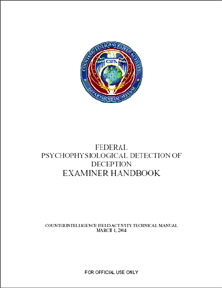
http://antipolygraph.org/documents/federal-polygraph-handbook-01-03-2004.pdf
Posted by George W. Maschke
- Nov 01, 2005, 03:53 PMAn early version of the Department of Defense Polygraph Institute's Federal Psychophysiological Detection of Deception Examiner Handbook (dated 1 December 1998 and marked "For Official Use Only") may be downloaded here (299kb PDF):
http://antipolygraph.org/documents/federal-polygraph-handbook-01-12-1998.pdf
According to the Department of Defense's polygraph program report to Congress for fiscal year 1998:
In 2002, AntiPolygraph.org requested the then current version of the Handbook (which was by then dated 3 July 2001) under the Freedom of Information Act. However, the Defense Security Service (DSS), DoDPI's then parent agency, withheld most of the Handbook. Those portions that were released may be downloaded here (1mb PDF):
http://antipolygraph.org/documents/federal-polygraph-handbook.pdf
Interestingly, DSS went so far as to redact certain items from the Handbook's glossary (no doubt in consultation with DoDPI). A comparison of the glossaries of the 1998 and 2001 versions reveals the "secret" definitions that DoDPI didn't want the public to know:
Also worth noting, the 2001 edition added two chapters not included in the 1998 edition: Chapter XVI (CI-Scope Polygraph Test) and Chapter XVII (Field Rank Order Scoring System).
http://antipolygraph.org/documents/federal-polygraph-handbook-01-12-1998.pdf
According to the Department of Defense's polygraph program report to Congress for fiscal year 1998:
QuoteIn Fiscal Year 1998, the Department published a handbook for all federal polygraph examiners which sets forth standardized techniques and procedures for conducting polygraph examinations. The handbook also outlines a Quality Assurance Program (QAP) wherein DODPI inspects federal polygraph programs to ensure compliance with both those techniques and procedures taught at DODPI and the continuing education requirements established by the polygraph community for polygraph examiners.
In 2002, AntiPolygraph.org requested the then current version of the Handbook (which was by then dated 3 July 2001) under the Freedom of Information Act. However, the Defense Security Service (DSS), DoDPI's then parent agency, withheld most of the Handbook. Those portions that were released may be downloaded here (1mb PDF):
http://antipolygraph.org/documents/federal-polygraph-handbook.pdf
Interestingly, DSS went so far as to redact certain items from the Handbook's glossary (no doubt in consultation with DoDPI). A comparison of the glossaries of the 1998 and 2001 versions reveals the "secret" definitions that DoDPI didn't want the public to know:
QuoteBreakdown Test - [only the second half of this definition was redacted] A test conducted to verify an examinee's statement regarding an issue after specific responses to one question have been observed and recorded during a screening examination. The issue is separated from the remaining test questions and a breakdown test is conducted. To devise appropriate breakdown questions, divide the issue into its logical components and design a question to cover each key area. The breakdown test can be conducted using an R/I format, or a comparison question format. If the results of the breakdown test clear the issue for which the test was conducted, a clearing test should be conducted.
Comparison Question - A question which is designed to produce a physiological response. The physiological responses of the comparison questions are compared to the physiological responses of the relevant questions.
The probable and directed lie are the two types of comparison questions utilized within the federal government.
Overall Truth Question - An optional question which may be utilized in an R/I question format. It is similar to the sacrifice relevant question in the comparison question format. It is intended to elicit a physiological response which may be indicative of the examinee's overall response capability.
Probable Lie Comparison (PLC) Question - A question designed to be a probable lie for the examinee. The DLC question should be similar in nature but unrelated to the specific crime or issue being tested. The question should be
separated from the relevant issue by either time, place or category. The comparison question should use the same action verb or similar in nature action verb as that of the relevant issue. A comparison question should be broad in
scope and time so that it captures as many of the examinee's past life experiences as possible.
Stimulus Question - A question which may be utilized in an R/I question format to determine the examinee's overall capacity for response.
Also worth noting, the 2001 edition added two chapters not included in the 1998 edition: Chapter XVI (CI-Scope Polygraph Test) and Chapter XVII (Field Rank Order Scoring System).