- Welcome to AntiPolygraph.org Message Board.

A forum for free and open discussion of polygraph-related topics
Posted by Trump2020
- Oct 28, 2018, 07:13 PMA user named Someguy0 on the federalsoup.com forum was recently banned and had his posts removed for posting the latest FBI polygraph questions. I was able to find the Google cache of the page, which used to be at https://forum.federalsoup.com/default.aspx?g=posts&t=81945, and here is a copy and paste of Someguy0's post:
---------------------
The FBI conducts their pre-employment polygraph at anyone of their offices around the U.S. An FBI Special Agent, who will brag about his polygraph training, will give your polygraph. The polygraph has two sets of questions, counterintelligence and lifestyle. In addition, there is a stupid pretest, a post test interrogations, and a repeat of questions. It will take about 4 hours total. During the pre-test, if you admit to anything in these counterintelligence or lifestyle areas, you will be drilled in that area. If you spike the charts during the actual test in any of these areas, you will be drilled during the post-test interrogation.
There are many questions that can be asked: List of possible FBI polygraph questions. Here are your likely questions:
The counterintelligence questions are broad enough to cover everything, so they are something like:
- Have you committed espionage against the U.S.?
- Have you supported terrorism against the U.S.?
- Have you had foreign contact with a foreign agency?
The lifestyle questions are also broad and may be something like:
- Did you try to research how to cheat the polygraph?
- Have you committed any serious crimes?
- Do you intend to lie to me?
- Have you ever told a lie since you were XX years old? This questions will come up in the pre-test and they will gauge how much you have lied to your parents over your whole life. They will pick an age as a threshold and use that.
The trick is, expect to be accused of lying, interrogated, and being told you are hiding something. Do not tell them anything, make no admissions. If you choose to use countermeasures, use the mental countermeasures described on the website Antipolygraph.org in the book The Lie Behind the Lie Detector. Do not try the breathing or biting countermeasures, they can be detected if you do them wrong.
Yes, I am exposing information here. Enjoy!
---------------------
The FBI conducts their pre-employment polygraph at anyone of their offices around the U.S. An FBI Special Agent, who will brag about his polygraph training, will give your polygraph. The polygraph has two sets of questions, counterintelligence and lifestyle. In addition, there is a stupid pretest, a post test interrogations, and a repeat of questions. It will take about 4 hours total. During the pre-test, if you admit to anything in these counterintelligence or lifestyle areas, you will be drilled in that area. If you spike the charts during the actual test in any of these areas, you will be drilled during the post-test interrogation.
There are many questions that can be asked: List of possible FBI polygraph questions. Here are your likely questions:
The counterintelligence questions are broad enough to cover everything, so they are something like:
- Have you committed espionage against the U.S.?
- Have you supported terrorism against the U.S.?
- Have you had foreign contact with a foreign agency?
The lifestyle questions are also broad and may be something like:
- Did you try to research how to cheat the polygraph?
- Have you committed any serious crimes?
- Do you intend to lie to me?
- Have you ever told a lie since you were XX years old? This questions will come up in the pre-test and they will gauge how much you have lied to your parents over your whole life. They will pick an age as a threshold and use that.
The trick is, expect to be accused of lying, interrogated, and being told you are hiding something. Do not tell them anything, make no admissions. If you choose to use countermeasures, use the mental countermeasures described on the website Antipolygraph.org in the book The Lie Behind the Lie Detector. Do not try the breathing or biting countermeasures, they can be detected if you do them wrong.
Yes, I am exposing information here. Enjoy!
Posted by Malleus Maleficarum
- Mar 24, 2004, 10:20 PMQuote from: Unfffingbelievable on Mar 24, 2004, 09:02 PMThere you go again George, you never passed a polygraph test, you never used any countermeasures, but yet you still hold yourself up as the final authority on both. Unfffingbelievable!!!
Unfffingbelievable,
Using that "logic" only a witch could opine on witchcraft.
Malleus
Posted by Unfffingbelievable
- Mar 24, 2004, 09:02 PMThere you go again George, you never passed a polygraph test, you never used any countermeasures, but yet you still hold yourself up as the final authority on both. Unfffingbelievable!!!
Posted by George W. Maschke
- Mar 24, 2004, 04:10 PMAnonymous,
An advantage to breathing countermeasures is that the pneumo tracings are the only ones that can be controlled directly (by consciously controlling one's breathing). At a minimum, one would want to avoid taking deep breaths and/or breathing "too slowly."
Like you, if I were somehow compelled to submit to a polygraph interrogation, I think I would opt for mental or cognitive countermeasures, which for me result in an associated breathing reaction without my having to make any special effort.
Additionally, the behavioral countermeasures described in Chapter 4 of The Lie Behind the Lie Detector should not be overlooked.
An advantage to breathing countermeasures is that the pneumo tracings are the only ones that can be controlled directly (by consciously controlling one's breathing). At a minimum, one would want to avoid taking deep breaths and/or breathing "too slowly."
Like you, if I were somehow compelled to submit to a polygraph interrogation, I think I would opt for mental or cognitive countermeasures, which for me result in an associated breathing reaction without my having to make any special effort.
Additionally, the behavioral countermeasures described in Chapter 4 of The Lie Behind the Lie Detector should not be overlooked.
Posted by beech trees
- Mar 24, 2004, 03:52 PMOh, well... if your only requisite for authority is successfully passing polygraphs while using countermeasures as outlined in the free book, The Lie Behind The Lie Detector, then I'm your man, as are many others who post here regularly. I used controlled breathing, anal pucker, and vivid imagery. Cheers,
Quote from: disgruntled polygrapher on Mar 24, 2004, 12:12 PMThis is beyond hilarity - here we have two guys, Annonymous and George, arguing about the correct way to use "countermeasures". Yet they both admit they have never used them on any of the polygraph tests they have failed. Talk about a couple of jerks!
Posted by Anonymous
- Mar 24, 2004, 03:46 PMGeorge,
My mistake with the confusion. However, I do know that the diagrams I mentioned were not from Williams' book as I have not read it yet. The source I'm most likely thinking of is a CD-ROM based publication (can't recall the name) that I found on www.911hotjobs.com, ironically enough. It contained diagrams quite similar to those you posted.
In any event, thank your for posting those diagrams. After reviewing the captions, I do see your point regarding countermeasure detection involving altered breathing patters. However, I am still skeptic and would feel more comfortable using cognitive countermeasures instead.
Thanks for the discussion.
My mistake with the confusion. However, I do know that the diagrams I mentioned were not from Williams' book as I have not read it yet. The source I'm most likely thinking of is a CD-ROM based publication (can't recall the name) that I found on www.911hotjobs.com, ironically enough. It contained diagrams quite similar to those you posted.
In any event, thank your for posting those diagrams. After reviewing the captions, I do see your point regarding countermeasure detection involving altered breathing patters. However, I am still skeptic and would feel more comfortable using cognitive countermeasures instead.
Thanks for the discussion.
Posted by Hilarious
- Mar 24, 2004, 12:12 PMThis is beyond hilarity - here we have two guys, Annonymous and George, arguing about the correct way to use "countermeasures". Yet they both admit they have never used them on any of the polygraph tests they have failed. Talk about a couple of jerks!
Posted by George W. Maschke
- Mar 24, 2004, 05:31 AMAnonymous,
You write, in part:
I think you might be confusing Doug Williams' "How to Sting the Polygraph" manual with Clifton's book (which has no illustrations). Williams maintains that one should breath so as to produce a rounded (non-jagged) pneumograph tracing. The following is quoted from the 2000 edition of "How to Sting the Polygraph":
However, in Reid and Inbau's textbook, Truth & Deception: The Polygraph ("Lie-Detector") Technique, sample charts of "truthful" subjects are shown with both rounded and jagged pneumo traces:
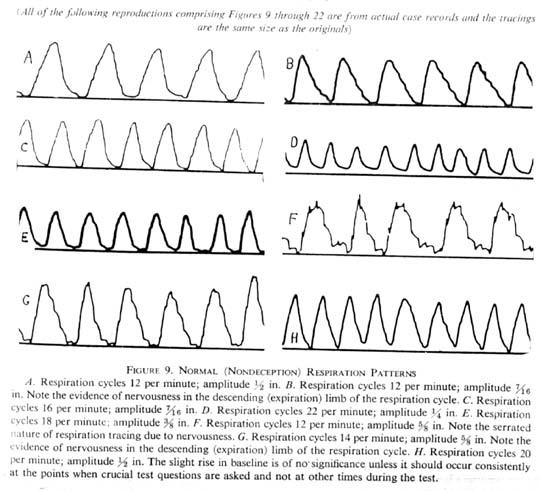
For related reading, see the discussion thread, How Countermeasures are Detected on the Charts in which a polygraph examiner (who posted as "J.B.") hypothesized that rounded respiratory tracings were a giveaway for countermeasure use.
Based on the available evidence, I think there is little cause for worry about whether one is producing a jagged or rounded pneumo tracing. Key points to bear in mind in establishing one's baseline breathing pattern are not to take deep breaths and not to breathe too slowly (15-30 breaths in-and-out per minute are considered "normal").
You write, in part:
QuoteGeorge, in regards to incorrectly attempted countermeasures, I did read in a book entitled "Deception Detection: Winning the Polygraph Game" by Charles Clifton that certain physical countermeasures (e.g. altered breathing), when used INCORRECTLY, can in fact alert the examiner to countermeasure attempt. Honestly, I don't see how this could not be the case. Unfortunately I don't have the book in front of me to quote but I do remember diagrams showing breathing pattern charts. I seem to remember one chart showing jagged points between inhales and exhales rather than a smooth transition. The caption indicated that these points can occur when an examinee incorrectly attempts to alter breathing patterns. The pattern is unnatural and identifiable as an attempt to use countermeasures.
This is what I was considering when I advised this person that, should he/she take the exam, he/she may want to consider not using countermeasures, at least physical countermeasures. I will look for the book and post more information.
I think you might be confusing Doug Williams' "How to Sting the Polygraph" manual with Clifton's book (which has no illustrations). Williams maintains that one should breath so as to produce a rounded (non-jagged) pneumograph tracing. The following is quoted from the 2000 edition of "How to Sting the Polygraph":
QuoteThe polygraher [sic] is constantly alert of a person who is controlling his breathing. (See Exhibit D) You will notice the difference between the normal and controlled breathing pattern. The controlled breather shows his attempt to control by consciously thinking of his breathing only to the point that he inhales and exhales, he breathes in and immediately breathes out, showing a jagged edged tracing. You should show a normal breathing pattern on all the questions except the control questions. I don't want you to be obvious about this, I simply want you to breathe the way you normally do - whatever is normal for you. A normal breathing pattern is one you can maintain easily for about ten minutes. You must spend some time practicing this so that it will appear "normal" on the chart.
When you answer the relevant questions, your breathing should appear even and restful. You have a pattern for a normal breathing if you simply breathe as though you are asleep and you are not aware of your breathing. Try to inhale and exhale the same amount of air each time in order to maintain the even baseline. This normal breathing pattern is what the polygrapher would expect to see from a cooperative, truthful person. Remember: (1) your breathing is recorded on the polygraph chart by the pneumo pens, (2) you must avoid a jagged edged breathing pattern, and (3) breathe as though you are breathing in a normal relaxed manner. Practice duplicating the normal breathing pattern until you can control your breathing without being obvious.
However, in Reid and Inbau's textbook, Truth & Deception: The Polygraph ("Lie-Detector") Technique, sample charts of "truthful" subjects are shown with both rounded and jagged pneumo traces:
For related reading, see the discussion thread, How Countermeasures are Detected on the Charts in which a polygraph examiner (who posted as "J.B.") hypothesized that rounded respiratory tracings were a giveaway for countermeasure use.
Based on the available evidence, I think there is little cause for worry about whether one is producing a jagged or rounded pneumo tracing. Key points to bear in mind in establishing one's baseline breathing pattern are not to take deep breaths and not to breathe too slowly (15-30 breaths in-and-out per minute are considered "normal").
Posted by Hilarious
- Mar 23, 2004, 09:21 PMQuote from: George W. Maschke on Mar 23, 2004, 04:56 AMConcerned Applicant,
With regard to your questions:
1. I cannot quantify how reliable the countermeasures described in Chapter 4 of TLBTLD are. The available peer-reviewed research (by Honts and collaborators, cited in the bibliography) shows that about 50% of untruthful subjects who used similar countermeasures (after a maximum of 30 minutes of instruction and training) passed.
In my opinion, however, the reliability of countermeasures is not sufficient to justify risking the serious harm associated with a false positive outcome on an FBI pre-employment polygraph examination. If I were in your shoes, I would withdraw my application for FBI employment before taking the polygraph.
2. Yes, but I think it is unlikely, unless the polygraph charts are accompanied by a derogatory admission that might preclude your holding a security clearance. I think what is more likely is that your polygraph results may become an issue when your security clearance comes up for a periodic review. For further information on polygraphs and security clearances, see "Use of the Polygraph in Security Clearance Investigations," Chapter 8 of Security Clearances and National Security Information: Law and Procedures written by Sheldon I. Cohen for the Defense Personnel Security Research Center.
3. I don't think so. If the FBI HQ polygraph unit deems you to be deceptive, your application will be rejected on that ground. By then, it would seemingly be too late to withdraw one's application. (I am not sure whether withdrawing your application even at this stage -- that is, before the polygraph -- would prevent an FBI HQ file from being opened. I suspect, but do not know for a fact, that it would not.)
4. I cannot recall any instances being reported to AntiPolygraph.org where the "complete honesty" approach produced favorable results during an initial FBI pre-employment polygraph examination. I can think of at least one instance where it was used with favorable results during a "re-test." (The polygraph requirement was not waived, but the applicant was scored "NDI" [No Deception Indicated].)
5. My qualifications to answer your questions derive from having closely followed polygraph matters for several years. For more on my own background, see my public statement, "Too Hot of a Potato: A Citizen Soldier's Encounter With the Polygraph".
So George, basically what you are saying is that your "qualifications" are that you have failed, (or been found to be lying) on two polygraph tests, that you have never used any of the "countermeasures" you advise other to use, and when confronted with a polygraph test you would simply tell people to run like hell.
Posted by Anonymous
- Mar 23, 2004, 07:42 PM"Using deceptive means to defeat a deceptive test is an ethical quandry I would not accept. I agree. I think that for an informed individual, choosing not to take the test at all is both wise and ethical. "
Marty, I think many would agree with this sentiment. However, the allure of a Special Agent position in the FBI can often outweigh the "ethical quandry" that forces one to choose. I admit that I am guilty of just that - overlooking the real issue in hopes of reaching the end.
Unlike some, I knew of this site before I took my first polygraph with the FBI. I was well aware of the risks involved and I chose to not employ countermeasures simply for ethical reasons. I failed. I was honest on the relevant questions, hence countermeasures were not necessary in my mind.
George, in regards to incorrectly attempted countermeasures, I did read in a book entitled "Deception Detection: Winning the Polygraph Game" by Charles Clifton that certain physical countermeasures (e.g. altered breathing), when used INCORRECTLY, can in fact alert the examiner to countermeasure attempt. Honestly, I don't see how this could not be the case. Unfortunately I don't have the book in front of me to quote but I do remember diagrams showing breathing pattern charts. I seem to remember one chart showing jagged points between inhales and exhales rather than a smooth transition. The caption indicated that these points can occur when an examinee incorrectly attempts to alter breathing patterns. The pattern is unnatural and identifiable as an attempt to use countermeasures.
This is what I was considering when I advised this person that, should he/she take the exam, he/she may want to consider not using countermeasures, at least physical countermeasures. I will look for the book and post more information.
Looking back, I'd have withdrawn my FBI application and waited for vacancies within agencies that do not use the polygraph. Hindsight, right?
Marty, I think many would agree with this sentiment. However, the allure of a Special Agent position in the FBI can often outweigh the "ethical quandry" that forces one to choose. I admit that I am guilty of just that - overlooking the real issue in hopes of reaching the end.
Unlike some, I knew of this site before I took my first polygraph with the FBI. I was well aware of the risks involved and I chose to not employ countermeasures simply for ethical reasons. I failed. I was honest on the relevant questions, hence countermeasures were not necessary in my mind.
George, in regards to incorrectly attempted countermeasures, I did read in a book entitled "Deception Detection: Winning the Polygraph Game" by Charles Clifton that certain physical countermeasures (e.g. altered breathing), when used INCORRECTLY, can in fact alert the examiner to countermeasure attempt. Honestly, I don't see how this could not be the case. Unfortunately I don't have the book in front of me to quote but I do remember diagrams showing breathing pattern charts. I seem to remember one chart showing jagged points between inhales and exhales rather than a smooth transition. The caption indicated that these points can occur when an examinee incorrectly attempts to alter breathing patterns. The pattern is unnatural and identifiable as an attempt to use countermeasures.
This is what I was considering when I advised this person that, should he/she take the exam, he/she may want to consider not using countermeasures, at least physical countermeasures. I will look for the book and post more information.
Looking back, I'd have withdrawn my FBI application and waited for vacancies within agencies that do not use the polygraph. Hindsight, right?
Posted by Marty
- Mar 23, 2004, 06:14 PMQuote from: George W. Maschke on Mar 23, 2004, 05:48 PMMarty, I agree that Anonymous' post was nuanced, but still there is no evidence that using or not using countermeasures has any effect on the liklihood of one's being accused of countermeasure use. In view of the high risk of a false positive outcome associated with CQT polygraphy in general and FBI pre-employment polygraph screening in particular, I think it would be unwise to not use countermeasures in hopes of increasing one's liklihood of being offered a "re-test" in the event one fails. (Feedback received by AntiPolygraph.org suggests that the results of re-tests are usually the same.) That said, I think the wiser course is not to take the FBI pre-employment polygraph at all.
Using deceptive means to defeat a deceptive test is an ethical quandry I would not accept. I agree. I think that for an informed individual, choosing not to take the test at all is both wise and ethical.
-Marty
Posted by George W. Maschke
- Mar 23, 2004, 05:48 PMMarty, I agree that Anonymous' post was nuanced, but still there is no evidence that using or not using countermeasures has any effect on the liklihood of one's being accused of countermeasure use. In view of the high risk of a false positive outcome associated with CQT polygraphy in general and FBI pre-employment polygraph screening in particular, I think it would be unwise to not use countermeasures in hopes of increasing one's liklihood of being offered a "re-test" in the event one fails. (Feedback received by AntiPolygraph.org suggests that the results of re-tests are usually the same.) That said, I think the wiser course is not to take the FBI pre-employment polygraph at all.
Posted by Marty
- Mar 23, 2004, 05:36 PMQuote from: George W. Maschke on Mar 23, 2004, 02:51 PMGeorge,
Actually, a polygrapher's determination that a subject employed countermeasures has no demonstrated connection with actual countermeasure use. The available peer-reviewed research (by Honts and collaborators) shows no such correlation.
I believe Anonymous' post was more nuanced. He specified "incorrectly applied CM's" as being more likely to be detected. There is certainly plenty of anecdotal evidence this is true. Someone that applies CM's to a relevant or neutral irrelevant will probably be seen as deceptive or using CM's.
It does seem likely that, as the examinee population becomes increasingly aware of how polygraphs actually work, the incidence of CM's will increase. Polygraphers will then be more likely to accuse examinees of CM's, whether used or not.
-Marty
Posted by George W. Maschke
- Mar 23, 2004, 02:51 PMAnonymous,
You write, among other things:
Actually, a polygrapher's determination that a subject employed countermeasures has no demonstrated connection with actual countermeasure use. The available peer-reviewed research (by Honts and collaborators) shows no such correlation.
In other words, there is no evidence that using countermeasures increases the likelihood that a polygrapher will conclude that countermeasures were employed. Conversely, there is no evidence that non-use of countermeasures decreases the likelihood that a polygrapher will conclude that countermeasures were employed.
You write, among other things:
QuoteIf you are set on the FBI, take the exam WITHOUT countermeasures and hope you pass. The reason I suggest not using countermeasures is simple. If you attempt them and use them incorrectly, the examiner MAY indicate that you attempted them in his/her results that are submitted to HQ. This will most likely preclude you from any possibility of a retest....
Actually, a polygrapher's determination that a subject employed countermeasures has no demonstrated connection with actual countermeasure use. The available peer-reviewed research (by Honts and collaborators) shows no such correlation.
In other words, there is no evidence that using countermeasures increases the likelihood that a polygrapher will conclude that countermeasures were employed. Conversely, there is no evidence that non-use of countermeasures decreases the likelihood that a polygrapher will conclude that countermeasures were employed.
Posted by Anonymous
- Mar 23, 2004, 01:12 PMConcerned Applicant,
Your concerns are quite justified. I have had experience with the FBI pre-employment polygraph as well. My answer to your question #3 would be a definite 'no.' As George stated, a file has already been opened for you with the FBI (i.e., even if you withdraw your application NOW it will still be known that you had at one time applied). If you fail the polygraph phase you will be disqualified as soon as headquarters has reviewed the results.
A few others here would agree with me that you are in a tough situation. I was in the same situation at one point. The information contained in this site, though I feel it is of great value and critical to furthering the changes that need to take place, can put applicants at a very unfair disadvantage in that knowing how the machine works makes it very difficult for it to be effective at all. Basically, you are now stuck between attempting countermeasures or attempting to be honest and hoping to pass (keep in mind the current pass rate is 50%). Without countermeasures and with the information you now have about the polygraph, passing is going to be difficult.
My advice to you is to first decide how important a position with the FBI is. I don't know what position you are applying for but if it is Special Agent, remember there are criminal investigator positions with other agencies that DO NOT require a pre-employment polygraph exam. You may want to consider dropping the FBI and seeking out those agencies.
If you are set on the FBI, take the exam WITHOUT countermeasures and hope you pass. The reason I suggest not using countermeasures is simple. If you attempt them and use them incorrectly, the examiner MAY indicate that you attempted them in his/her results that are submitted to HQ. This will most likely preclude you from any possibility of a retest. However, if you indicate deception and the examiner does not necessarily indicate that you attempted countermeasures (although it seems they will always ask if you did), you MAY get a retest. If you get a retest, try the complete honesty approach then.
I apologize for the long post and good luck. BTW, I failed to ask before - will you be answering the relevant questions truthfully or do you need to lie on those to pass? If you do need to lie, I would suggest dropping your application now. Good Luck.
Your concerns are quite justified. I have had experience with the FBI pre-employment polygraph as well. My answer to your question #3 would be a definite 'no.' As George stated, a file has already been opened for you with the FBI (i.e., even if you withdraw your application NOW it will still be known that you had at one time applied). If you fail the polygraph phase you will be disqualified as soon as headquarters has reviewed the results.
A few others here would agree with me that you are in a tough situation. I was in the same situation at one point. The information contained in this site, though I feel it is of great value and critical to furthering the changes that need to take place, can put applicants at a very unfair disadvantage in that knowing how the machine works makes it very difficult for it to be effective at all. Basically, you are now stuck between attempting countermeasures or attempting to be honest and hoping to pass (keep in mind the current pass rate is 50%). Without countermeasures and with the information you now have about the polygraph, passing is going to be difficult.
My advice to you is to first decide how important a position with the FBI is. I don't know what position you are applying for but if it is Special Agent, remember there are criminal investigator positions with other agencies that DO NOT require a pre-employment polygraph exam. You may want to consider dropping the FBI and seeking out those agencies.
If you are set on the FBI, take the exam WITHOUT countermeasures and hope you pass. The reason I suggest not using countermeasures is simple. If you attempt them and use them incorrectly, the examiner MAY indicate that you attempted them in his/her results that are submitted to HQ. This will most likely preclude you from any possibility of a retest. However, if you indicate deception and the examiner does not necessarily indicate that you attempted countermeasures (although it seems they will always ask if you did), you MAY get a retest. If you get a retest, try the complete honesty approach then.
I apologize for the long post and good luck. BTW, I failed to ask before - will you be answering the relevant questions truthfully or do you need to lie on those to pass? If you do need to lie, I would suggest dropping your application now. Good Luck.